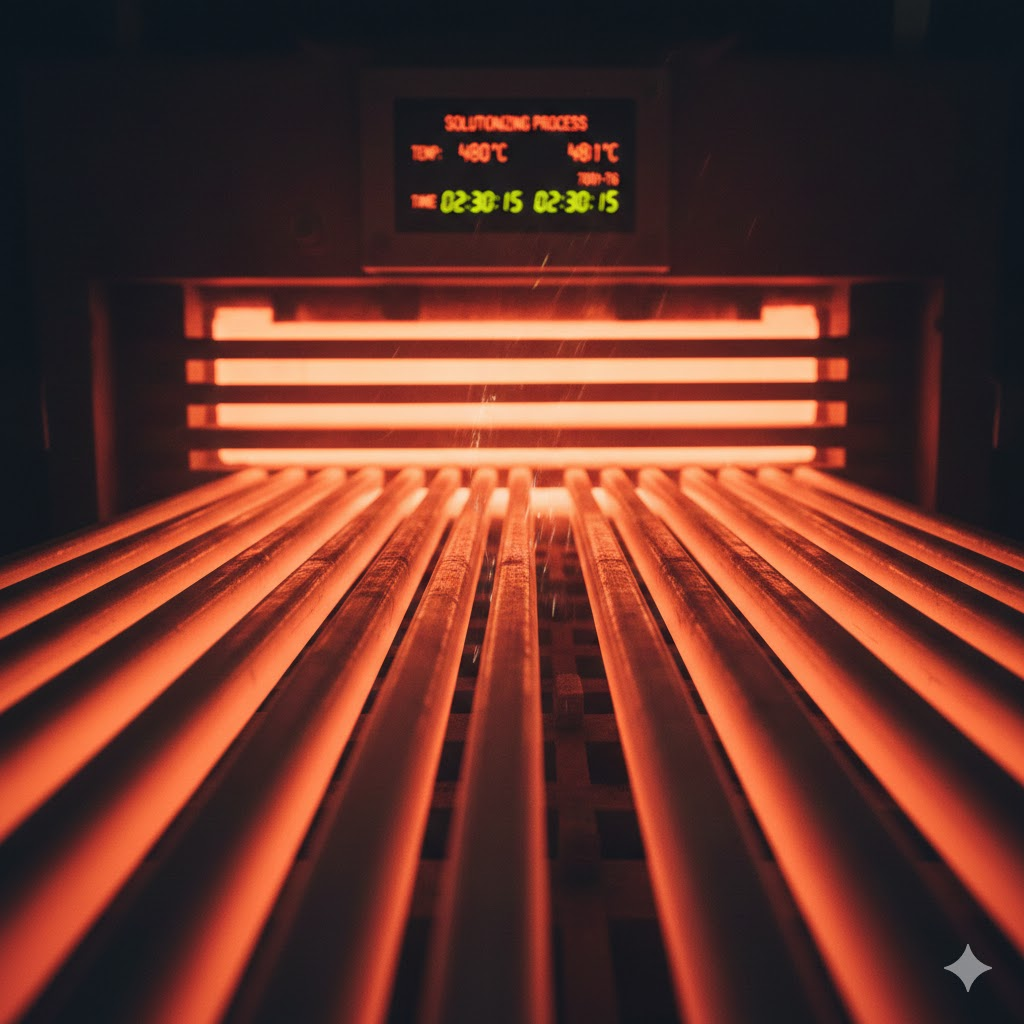
WelcoWelcome to the fourth installment of our comprehensive series on the manufacturing of professional-grade tent poles. Having mastered the precision drawing and sizing in our previous chapter, we now stand at the most critical juncture of metallurgical engineering: The T6 Heat Treatment.
While many casual observers see aluminum as a singular material, industry veterans know that the “7001” designation is merely a foundation. The true “soul” of the material—its legendary tensile strength and elastic modulus—is forged through a highly controlled sequence of thermal manipulation. In this guide, we will explore the intricate relationship between Solutionizing, Quenching, and Precipitation Hardening, revealing the proprietary field secrets that separate world-class 7001-T6 components from standard 6061-series alternatives.
1. Solutionizing and the Critical Quench: Sealing the Atomic Door
The journey to 7001-T6 strength begins with a two-step thermal process: Solutionizing immediately followed by a high-velocity Quenching. At this stage, the drawn aluminum pipes are structurally “reset.” To achieve the required physical properties, we must facilitate a process of internal diffusion where alloying elements—primarily Zinc (Zn) and Magnesium (Mg)—interact with the aluminum matrix at an atomic level.
The Precision of Thermal Soaking (Solutionizing)
Unlike the more forgiving 6000-series alloys, 7001 requires a stringent thermal window. We subject the material to temperatures ranging between 450°C and 500°C for a duration of 2 to 3 hours. This is not merely about heating the metal; it is about providing the necessary kinetic energy for the atoms to dissolve into a single-phase solid solution.
The soaking time is a variable equation dictated by the pipe’s wall thickness and total volume. If the duration is too short, the elements remain segregated, leading to weak spots. If too long, we risk Grain Coarsening, which permanently degrades the fatigue resistance of the tent pole.
The Quenching Dynamics: The Decisive Act of “Freezing”
The most vital sub-step is the Quench. Imagine the high-temperature state as a door that is wide open, allowing atoms to move freely. To maintain this “supersaturated” state at room temperature, we must slam that door shut before the atoms can reorganize. This requires the material to be fully submerged in a cooling medium within a matter of seconds. In the field, we often say that the Quenching is where the actual strength is “born,” as it preserves the potential for later hardening.
The Professional Secret: Quenching Medium and Oil-Infused Cooling
One of the most significant challenges in high-temperature Quenching is the Leidenfrost Effect. When a 500°C aluminum tube hits water, an instantaneous vapor barrier forms around the surface. This steam pocket acts as an insulator, drastically reducing the cooling rate and ruining the material’s potential strength.
To counteract this, elite manufacturing facilities utilize Oil-Infused Water or specialized Polymer Quenchants. These additives collapse the vapor blanket immediately, ensuring a uniform and rapid heat extraction. This is a nuance rarely mentioned in textbooks but practiced religiously in top-tier facilities to ensure the 7001 alloy reaches its maximum theoretical yield strength. In some heavy-duty industrial applications, Oil Quenching alone is utilized to manage the thermal shock more effectively.
2. Straightening: Navigating the Golden Window of Ductility
A 7001 pipe emerging from the Quench tank is often a sight of chaos. The violent thermal contraction from the Quenching process causes the pipes to warp and twist—a phenomenon known as thermal distortion. While Straightening (Leveling) is the mechanical solution, the engineering challenge lies in the Incubation Period.
The 1-2 Hour Rule: The Veteran’s Gold Standard
Immediately after Quenching, the 7001 alloy exists in a metastable “W” temper. In this state, the material is surprisingly ductile because the hardening elements are trapped in solution. However, Natural Aging begins the second the material hits room temperature. As Zinc and Magnesium atoms begin their slow migration, the alloy’s hardness and elasticity climb exponentially.
From my 15 years in the field, I can confirm that the “1-2 Hour Window” is non-negotiable. Straightening the pipes within this window—post-quench—allows for perfect linearity without inducing micro-fractures. If you attempt to straighten the material after 4 or 5 hours of natural aging:
- Work Hardening: The material resists the rollers, leading to “Spring-back,” where the pipe refuses to stay straight.
- Structural Integrity: The internal tension can cause the alloy to “snap” or develop latent stress points that will fail under the heavy wind loads of a mountain environment.
Precision Roller Engineering
We utilize multi-axis Roller Leveling machines equipped with Urethane or Stainless Steel (SUS) rollers. Urethane is preferred for premium tent poles because it provides the necessary friction to straighten the tube without marring the pristine surface of the aluminum, which is essential for the subsequent anodizing process.
[Consolidated Engineering Matrix: 7001-T6 Thermal Dynamics]
| Engineering Phase | Target Microstructure | Temperature Range | Process Criticality |
| Solutionizing | Single Phase Solid Solution | 450–500°C | Homogeneous Atomic Diffusion |
| Quenching | Supersaturated Solid Solution (SSS) | Rapid Drop (<10s) | Prevention of Coarse Precipitation |
| Straightening | Stress-Relieved Geometry | Room Temp | The 1-2 Hour Window (Post-Quench) |
| Artificial Aging | Optimal GP Zones & $\eta’$ Phases | 120–150°C | Maximum Peak Hardness (T6) |
3. Artificial Aging: The Final Ascent to T6 Greatness
The transformation is completed through Artificial Aging (Precipitation Hardening). While natural aging takes weeks to stabilize and often lacks the necessary peak strength, artificial aging uses controlled thermal energy to accelerate the formation of strengthening precipitates.
The Alchemy of Precipitation
During aging, the pipes are placed in an oven at a relatively low temperature (120–150°C) for an extended period. This triggers the formation of sub-microscopic particles (precipitates) that act as “anchors” within the atomic lattice. These anchors prevent the metal planes from sliding over one another, which is the literal definition of “strength” in metallurgy.
Precision Timing and the “Over-Aging” Trap
Every reputable manufacturer has a proprietary T-t (Temperature-time) Curve. If the material stays in the aging oven for even 30 minutes too long, the precipitates grow too large—a state called Over-aging. Over-aged 7001 loses its “spring” and becomes brittle, losing the very elasticity that makes it the premier choice for high-end trekking tents.
The 7001-T6 poles that eventually reach your hands have survived this gauntlet of fire and ice. They represent a perfect harmony of chemical composition and thermal precision, with Quenching serving as the pivotal anchor for all subsequent mechanical excellence.
Expert Insight for Professional Gear Enthusiasts
The 7001-T6 heat treatment is not a mere “manufacturing step”—it is a sophisticated metallurgical journey. When you hold a 7001-T6 pole, you are holding the result of a battle against thermodynamics, where 1 degree of temperature or 10 seconds of Quenching delay can be the difference between a masterwork and scrap metal.
In our next installment, Part 5, we will explore the final aesthetic and protective layer: The Anodizing Process. We will look at how we protect this hardened alloy from the elements while giving it the signature colors of the world’s most iconic tent brands.
Was this deep dive helpful? Understanding the thermal history and the importance of the Quenching process is the first step toward appreciating its true value. Stay tuned for our next guide on surface treatments and final quality control!