1. Introduction: Why the Masses Mistake Opportunity for Crisis
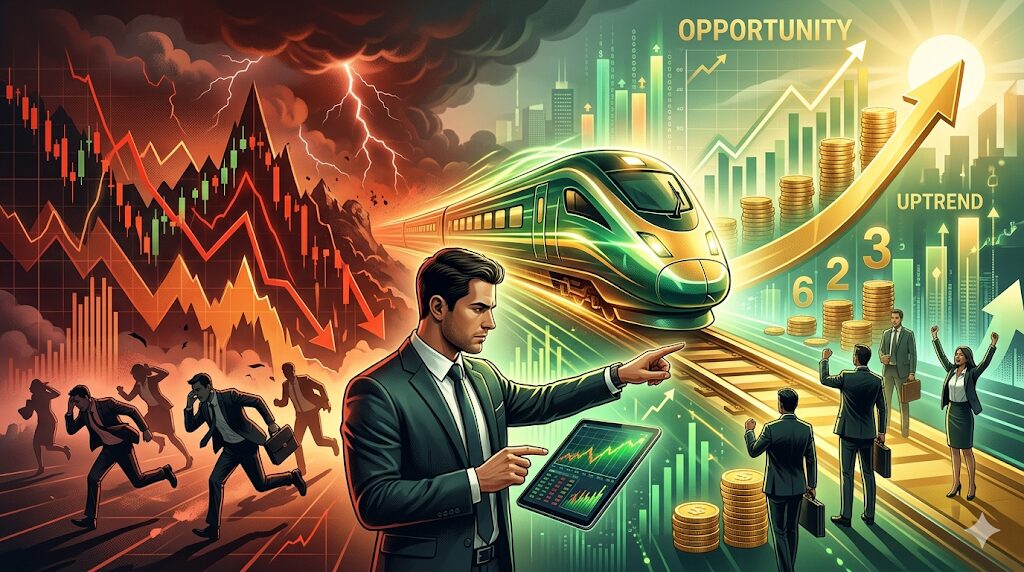
In the financial markets, opportunity is almost always disguised as fear. It’s easy to look back and say, “I should have bought the dip,” but at the moment of peak volatility, most investors are paralyzed by the sight of red in their portfolios. When I called the early April correction the “final boarding zone,” it wasn’t a guess—it was an analysis of market mechanics that the general public often overlooks.
While the majority are distracted by macroeconomic noise, seasoned investors who understand the “DNA of the market” take action. Opportunities are persistent, but only a few possess the discipline to “pick them up.” In this post, we will dissect why the recent downturn was not a sign of collapse, but a necessary reset for a massive bull run.
2. The Macro Trap: Oil, Inflation, and the Truth About Rates
Many pundits argue that rising oil prices will reignite inflation, forcing the Fed to keep rates high and crashing the market. This is a one-dimensional interpretation of a complex system.
2.1 Why Oil Surges Rarely Trigger Sustainable Inflation Now
The current spike in oil prices is driven by geopolitical supply constraints, not an explosion in global demand. Historically, supply-side oil shocks are self-correcting because they act as a “tax” on consumers. Higher energy costs reduce discretionary spending, which actually chills the broader economy and dampens inflationary pressures.
2.2 High Rates as a Sign of Economic Resilience
A prolonged period of high interest rates indicates that the underlying economy is incredibly robust. The true danger is a rapid rate cut triggered by a hard landing. As long as corporate earnings remain resilient in a high-rate environment, institutions view this as the “Season of Accumulation.”
[The Smart Money Checklist]
- [ ] Is the drop caused by fundamental earnings failure or temporary sentiment?
- [ ] Has the Fear & Greed Index reached “Extreme Fear”?
- [ ] Is M2 Money Supply still showing a long-term expansionary trend?
- [ ] Will geopolitical events permanently alter the long-term earnings of core sectors?
3. The Psychology of FOMO: How Markets Seduce Capital
The market is designed to transfer wealth from the impatient to the patient. We are currently in a phase where a sharp recovery is met with deep skepticism—a perfect breeding ground for a “seduction rally.”
3.1 The “Small Money” Experiment
After a scare, retail investors don’t commit large sums immediately. They test the waters with small amounts. The market then ensures these small positions grow rapidly and effortlessly. This creates a psychological “hook.” Once the retail investor is convinced that “it’s safe,” they move their life savings into the market.
3.2 The Departure of the High-Speed Train
The market typically peaks only after the “big money” from retail investors has been fully committed. Since we are still in a phase where people feel FOMO but remain hesitant, it indicates that there is significant “fuel” left for the upward move.
4. Institutional Manipulation and the AI Bubble Narrative
Institutional players never buy at the top. If they haven’t secured their desired positions, they will use any news—even good news—to drive the price down and shake out weak hands.
4.1 The Hidden Agenda Behind the News
When AI giants report record-breaking earnings yet the stock price drops on “bubble concerns,” it’s often a calculated move by institutions to accumulate more shares at a discount. The recent conflict in the Middle East provided the perfect cover for this accumulation phase.
4.2 The Role of MMF Liquidity
Trillions of dollars are currently sitting in Money Market Funds (MMFs). This capital is waiting for a “confirmation” of a bull market. Institutions are positioning themselves now so they can sell to this massive wave of liquidity once the “all-clear” signal is given.
5. Conclusion: Risk Management and the Upside Potential
Investing is not about predicting the future with a crystal ball; it’s about managing risk and positioning yourself for the highest probability outcomes.
The accumulation phase, accelerated by recent geopolitical fears, appears largely complete. As the high-speed train leaves the station, the narrative will shift from “imminent crash” to “unstoppable rally.” Don’t be the investor who watches from the sidelines as the train accelerates. Understand the cycles, ignore the noise, and focus on the structural drivers of growth.