
1. A 10-Year Tragedy: Kimbap Rose 150%, My Salary Rose 10%
Nothing makes us feel the decline in purchasing power more painfully than our daily meals. Ten years ago, a roll of Kimbap (a popular Korean seaweed rice roll) was a cheap, go-to meal for young professionals, costing around 1,500 to 2,000 KRW (approx. $1.10 – $1.50). Today, in 2026, we pay 5,000 KRW (approx. $3.40) for that same roll. That is a 150% increase.

Now, let’s look at the starting salary for an entry-level employee at a mid-sized Korean firm. Ten years ago, it was around 30 million KRW. Today, it hovers between 32 and 34 million KRW—a meager 10% increase. While 10,000 KRW used to buy a full feast of Kimbap, Ramen, and Tteokbokki, it barely covers Kimbap and Ramen today. Income simply cannot keep up with the speed of currency devaluation.
2. The Trap of “Lack of Memory”
The bigger issue lies with the younger generation entering the workforce now. Since they haven’t experienced the prices of the past, they accept today’s abnormal inflation as “normal.”
When I first started working, earning 2.3 million KRW a month allowed me to pay rent, go on dates, and still save over 50% of my income. Today, expecting the same savings rate from the youth is mathematically nearly impossible. We shouldn’t dismiss their low savings rates as a “lack of will”; it is a systemic result of the fundamental decline in the value of money.
3. The Samsung Electronics Trap: The Mask of Exchange Rates
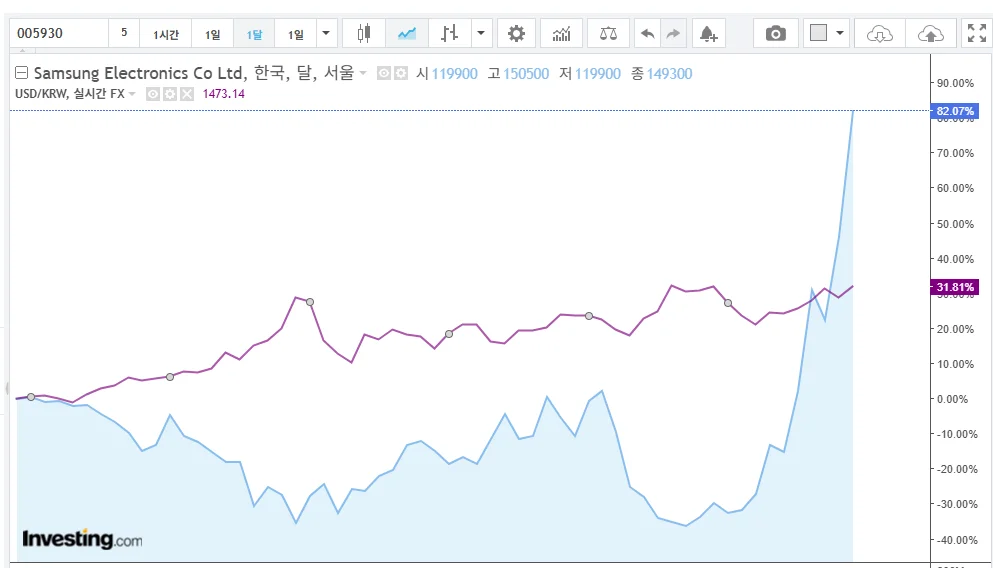
The KOSPI is heading toward 5,000 points, and Samsung Electronics has hit 148,000 KRW. Those who held through the 2021 peak of 90,000 KRW might feel like they’ve won big. However, we must evaluate this value against the global reserve currency (USD).
- 2021 Peak: Samsung Electronics at 91,000 KRW / Exchange Rate: 1,100 KRW per USD
- 2026 Present: Samsung Electronics at 148,000 KRW / Exchange Rate: 1,470 KRW per USD
While the stock price rose by 163%, the value of the Korean Won (KRW) dropped by 134%. After adjusting for the currency devaluation, the real profit after five long years of waiting is only about 25-30%. In contrast, what if you had invested in the S&P 500 during the same period? You would have enjoyed a “double-profit” structure: the growth of the index itself (145%) plus the gain from the rising USD/KRW exchange rate (134%). This isn’t just hindsight; it’s a result that could have been prepared for by simply being vigilant about the declining value of the Won.
4. Conclusion: In Which Country’s Real Assets Will You Store Your Wealth?
The future direction is clear. The global market will continue to print more money. Governments will attempt to manage debt ratios through productivity gains from AI and GDP growth. As the money supply increases, the “value” of money is diluted, effectively shrinking the burden of debt.
In an era where nations constantly dilute their currency, we must ask ourselves: “Into which country’s real assets will I convert and store the value of my labor?”
There is no single right answer. However, if we fail to read the flow of currency value, we will never escape the cycle of becoming poorer, no matter how hard we work.