
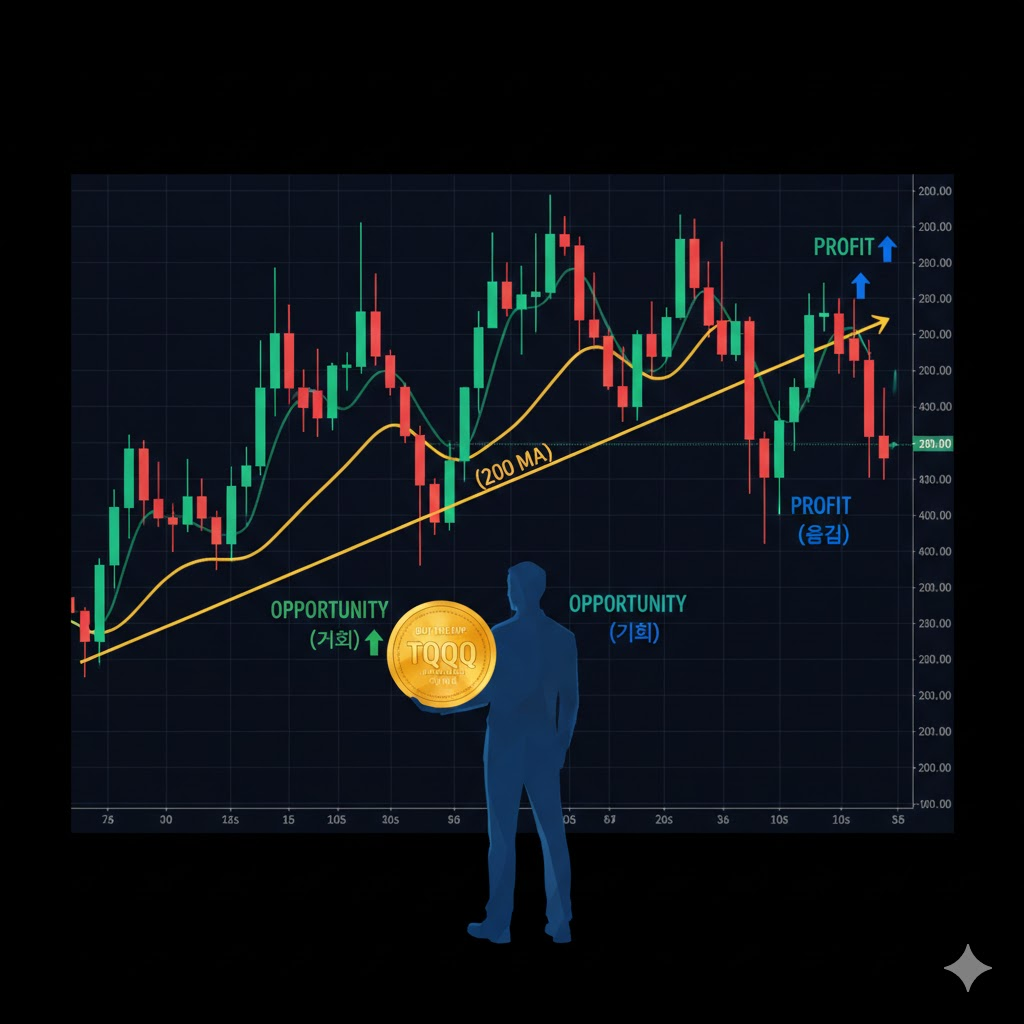
Why You’re Calm About Real Estate but Panic at TQQQ: The “20% Disparity” Strategy for Wealth
Investors often exhibit a strange, almost irrational duality. They remain remarkably stoic when the value of their primary residence—often accounting for 80% of their net worth—dips by six figures. Yet, when TQQQ, a curated basket of the world’s most dominant tech innovators, touches the 200-day moving average, they fall into a tailspin of panic.
As a seasoned 15-year veteran in global SEO and investment strategy, I am here to tell you that this psychological friction is exactly where the greatest wealth opportunities are hidden. To master the 3x leveraged Nasdaq-100 ETF, you must move beyond emotional “vibes” and adopt a cold, mechanical algorithm. Today, we break down the 200-Day Moving Average Entry and the 20% Disparity Exit Strategy.
1. Decoding the TQQQ DNA: CAGR, MDD, and the Split Cycle
Before you even think about putting a single dollar into a leveraged product, you must understand the mathematical beast you are trying to ride. TQQQ is not a gamble; it is a high-performance engine that requires a disciplined operator.
- CAGR (Compound Annual Growth Rate): Over the last decade, TQQQ has delivered a jaw-dropping CAGR of approximately 35% to 40%. In a secular bull market, this means your capital can double every two to three years. This is the “Alpha” that keeps institutional and retail whales hooked.
- MDD (Maximum Drawdown): High octane comes with high risk. During the 2022 bear market, TQQQ suffered a drawdown of nearly 80%. If you cannot psychologically survive seeing $100,000 turn into $20,000 on your screen, leverage is a dangerous weapon for you.
- The Stock Split Phenomenon: TQQQ frequently undergoes forward splits (most recently a 2:1 split in late 2025). When the price exceeds the $150-$200 range, ProShares splits the stock to maintain liquidity. This is a sign of long-term structural health and provides a psychological boost to retail accumulators who love seeing their share count grow.
[TQQQ Fundamental Performance Table]
| Metric | Historical Value | Investor Takeaway |
| Avg. Annual Return (CAGR) | 35% – 40%+ | Wealth acceleration is exponential. |
| Max Drawdown (MDD) | Up to -80% | You must buy when others are screaming. |
| Expense Ratio | ~0.95% | Already baked into the price; ignore the noise. |
| Liquidity & Volume | Ultra-High | Massive AUM ensures easy entry and exit. |
2. The Mechanical Algorithm: 200-Day MA Buy & 20% Disparity Sell
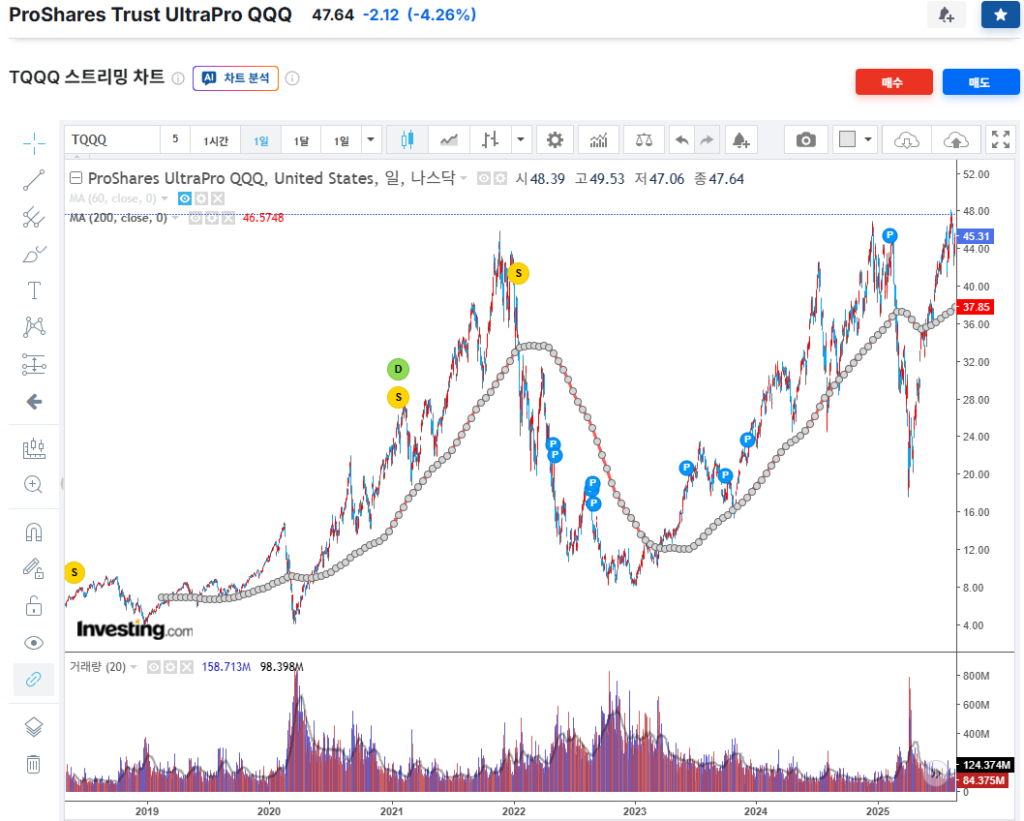
Why do most retail traders fail? Because they buy when the RSI is overbought and sell when the fear index is at its peak. Our strategy flips the script. We use the 200-Day Simple Moving Average (SMA) as our primary anchor.
The Entry Strategy: Buying the “Digital Ground Floor”
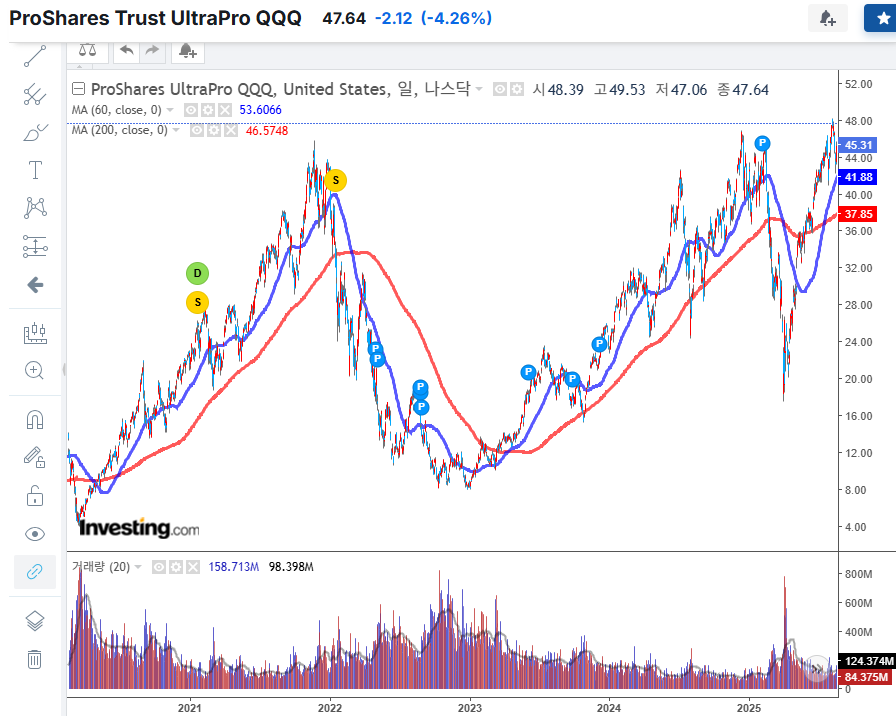
The 200-day SMA is the long-term trend line of the market. When the TQQQ price touches or falls below this line, it signals that the Nasdaq-100 is overextended to the downside.
- Action: Initiate fractional buying (DCA) in 3 to 5 tranches once the price hits the 200-day SMA.
- Mindset: This is your “Digital Real Estate” going on a 30-50% sale.
The Exit Strategy: The 20% Disparity Rule (New Update)
Instead of using a short-term 5-day moving average, we now focus on the Disparity Ratio. We want to capture the meat of the move while exiting before the volatility drag begins to erode our 3x gains.
- The Formula: Monitor the gap between the current price and the 200-day SMA.
- The Target: Once the price is 20% higher than the current 200-day SMA price, start your exit plan.
- Example: If the 200-day SMA is currently sitting at $50, your sell orders should start triggering once TQQQ reaches $60.
- Why 20%? This specific threshold usually captures the initial vertical recovery phase of the Nasdaq before it enters a potentially choppy, sideways consolidation zone where leverage decay thrives.
3. The Math of Decay: Why You Can’t “Wait” in Sideways Markets
Critics often point to “Negative Compounding” or “Volatility Drag” as a reason to avoid 3x ETFs. They aren’t wrong about the math, but they are often wrong about the strategy. TQQQ rebalances daily, which creates a mathematical friction in non-trending markets.
The Mathematical Example of the “Melt”:
- Imagine the underlying Nasdaq-100 index starts at $100.
- Day 1: Index rises 10% → $110. TQQQ rises 30% → $130.
- Day 2: Index falls 9.09% → $100 (Back to breakeven).
- TQQQ falls 27.27% (3x 9.09%) → $94.55.The Result: The index is flat, but your TQQQ is down 5.45%.
This is precisely why we do not “hope” for a recovery. We enter at the 200-day MA to catch the upward momentum and exit at a 20% disparity to avoid being caught in the “sideways melt.” Also, ignore the talk about interest-rate-linked fees. While they exist, they are integrated into the daily NAV. Your only job is to focus on the price action relative to the trend line.
4. Re-framing the Mindset: Stocks as Products, Not Numbers
The reason we are sensitive to stock drops is that they are liquid and constantly visible. Your house price doesn’t flash red in your living room every 5 seconds. To succeed in TQQQ, you must treat it like a physical commodity.
Shift from “Profit-Hunting” to “Share-Accumulating”
If the price drops further after you enter at the 200-day MA, do not panic. Pivot your strategy immediately.
- Forced HODL: If the 200-day line breaks, stop looking at the percentage loss. Start looking at your Share Quantity.
- Active Income Deployment: Use your salary or business income to buy even more. Think of it as a “Buy One, Get One Free” sale at your favorite luxury store.
- Psychology: We find joy when a $1,000 TV is on sale for $500. We should feel that same rush when TQQQ—the collective intelligence of Google, Nvidia, and Apple—is on sale at the 200-day MA.
5. Summary: The Discipline of the “Boring” Rich
Real wealth is built through boring, repetitive actions.
- Wait for the 200-day MA.
- Buy the dip systematically.
- Accumulate like a hoarder if it goes lower.
- Sell when the disparity hits 20%.
The current proximity of TQQQ to its 200-day moving average is a rare signal. It is a moment to decide: will you be a “tourist” who panics at the red numbers, or an “owner” who treats this as a generational opportunity to acquire digital real estate at a massive discount? Stick to the 20% disparity rule, ignore the decay noise, and let the compounding power of the Nasdaq-100 do the heavy lifting for you.