
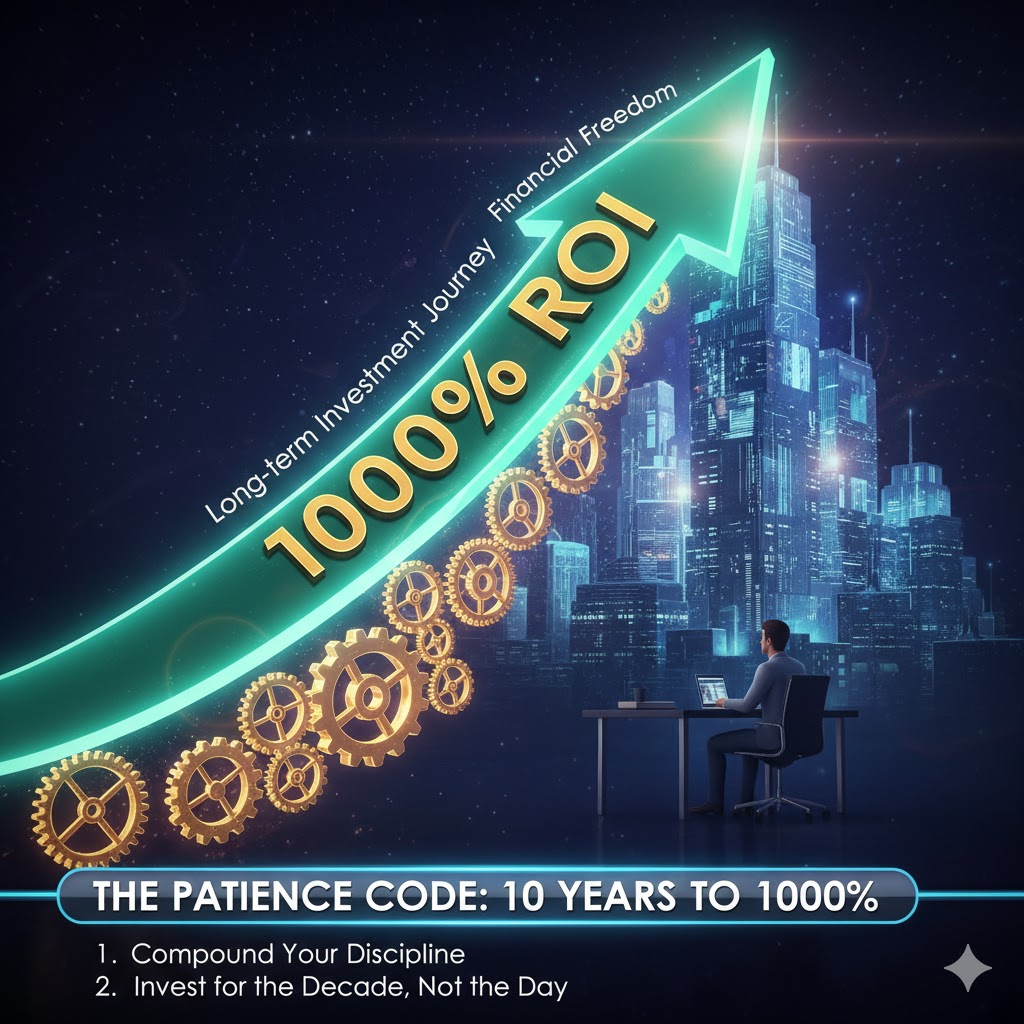
1. The 50-Year Nasdaq Saga: The Gravity of Human Progress
1.1 From 100 to 20,000: More Than Just Numbers
On February 5, 1971, the NASDAQ Composite started at a base of 100. Today, it stands as a testament to the relentless march of technology, hovering above 20,000 points. This 10.5% CAGR (Compound Annual Growth Rate) represents the collective intelligence of humanity—from the first microchips to the current AI revolution. Investing in the Nasdaq isn’t gambling; it’s buying a stake in the future of civilization.
1.2 The Paradox of the Retail Investor
As a 15-year market veteran, I’ve seen the same tragedy play out repeatedly. The index goes up, but the investor’s balance goes down. Why? Because the human brain is hardwired for survival, not for the abstract mathematics of compounding. We are biologically programmed to feel fear when our “digital berries” disappear by 3% in a day. To win, you must realize that the market doesn’t reward the smartest; it rewards the most emotionally stable.
1.3 The Devaluation of Fiat: Why Real Assets are Mandatory
Underpinning every bull market is the constant expansion of the money supply. Central banks are in a perpetual race to devalue their currencies to keep the global debt machine running. When you hold cash for 10 years, you aren’t “safe”; you are suffering a guaranteed loss in purchasing power. Equity is the ultimate hedge. Rising stock prices are often just the market “correcting” for the weakening of the dollar.
2. The 80/20 Tactical Buffer: Engineering Your Discipline
2.1 Don’t Fight Your Nature; Manage It
The biggest lie in investing is that you can simply “will” yourself to be patient. Willpower is a finite resource. Instead of fighting your dopamine-seeking brain, you should satisfy it within a controlled environment. This is the core of the 80/20 Psychological Buffer Strategy. It’s about creating a cage for your inner speculator so your inner investor can thrive.
2.2 The 80% Core: The Silent Compounder
80% of your wealth belongs in the “Vault.” This is your long-term, passive capital allocated to low-cost index funds like the Nasdaq 100 (QQQ). This money is “dead” to you for the next decade. It doesn’t care about inflation, elections, or quarterly earnings. Its only job is to capture the upward trajectory of the global economy. By automating this portion, you remove the “Human Error” from your greatest wealth-building engine.
2.3 The 20% Satellite: The Dopamine Playground
The remaining 20% is your “Sacrificial Lamb.” Use this account to trade crypto, chase memes, or bet on the next big tech trend. This account satisfies your primal urge to “do something.” Because you are actively managing this 20%, your brain feels “in control,” allowing you to leave the critical 80% undisturbed. If this 20% thrives, it’s a bonus; if it fails, your future is still secured by the 80% bedrock.
Strategic Asset Allocation Matrix
| Feature | Core Portfolio (80%) | Satellite Account (20%) |
| Philosophy | Bet on Human Progress | Bet on Market Volatility |
| Assets | QQQ, SPY, Blue-chip Tech | Individual Stocks, Options, Trends |
| Time Horizon | 10+ Years (The Infinite Game) | Days to Months (The Tactical Game) |
| Maintenance | Set it and Forget it (Passive) | High Engagement (Active) |
| Psychological Goal | Peace of Mind & Security | Excitement & Market Pulse |
| Risk Outcome | Guaranteed by Capitalism | Potential Alpha or “Tuition” |
3. Warren Buffett’s Secret: It’s Not IQ, It’s Temperament
3.1 Why the Oracle Stays in Omaha
Warren Buffett doesn’t live in Omaha because he likes the weather. He stays there to insulate himself from the “Institutional Imperative” and the madness of Wall Street. He knows that constant information is the enemy of wisdom. He has built a career not on being a genius mathematician, but on being an extraordinary practitioner of emotional restraint.
3.2 The Arbitrage of Patience
The market is a massive mechanism designed to transfer wealth from the “Impatient” to the “Patient.” In the 100-day game we discussed, Buffett is the one who calmly waits while everyone else panics at day 30. He understands “Emotional Arbitrage”—the profit made by staying rational when everyone else is acting on instinct. By adopting the 80/20 rule, you are essentially outsourcing your discipline to a system, making you a “Buffett-lite” investor.
3.3 Staying within the Circle of Competence
Buffett’s refusal to invest in what he doesn’t understand is the ultimate form of ego suppression. During the Dot-com bubble, he was called a “relic.” He didn’t care. He stayed within his circle, and when the dust settled, he was the one with the capital to buy the survivors at a discount. Your 80% core is your circle of competence—the undeniable growth of the world’s most innovative companies.
4. The Chasm of Wealth: How the Gap Becomes Absolute
4.1 The Compounding of Small Psychological Wins
The wealth gap isn’t built in a day. It’s built in the moments of crisis. While the masses are selling their future for a bit of temporary comfort, the patient 1% are doubling down. These small, counter-intuitive decisions compound over decades. By the time 20 years have passed, the difference in net worth between the “Reactor” and the “Investor” is no longer a gap—it’s a canyon.
4.2 Mastering the Relativity of Time
Future time always feels longer than past time. This is a biological illusion that kills compounding. To counter this, stop measuring your success in days. Measure it in decades. Use the 20% satellite account to keep your “now-focused” brain happy, but keep your 80% anchor deep in the future.
4.3 Final Roadmap for the Stoic Investor
- Platform Separation: Do not keep your 80% and 20% in the same app. Out of sight, out of mind.
- Embrace the Boredom: Real investing is like watching paint dry. If you want excitement, go to the casino or use your 20% account.
- The Volatility Tax: Accept that a -30% drop is the “fee” you pay for the 10.5% “reward.”
- Zero Comparison: Your path to wealth is private. Ignore the “overnight millionaires” on social media. They are the outliers; the 80/20 rule is the law.