
winds
1. The Physics of Wind: Why 22mph is the “Critical Threshold” for Sleep
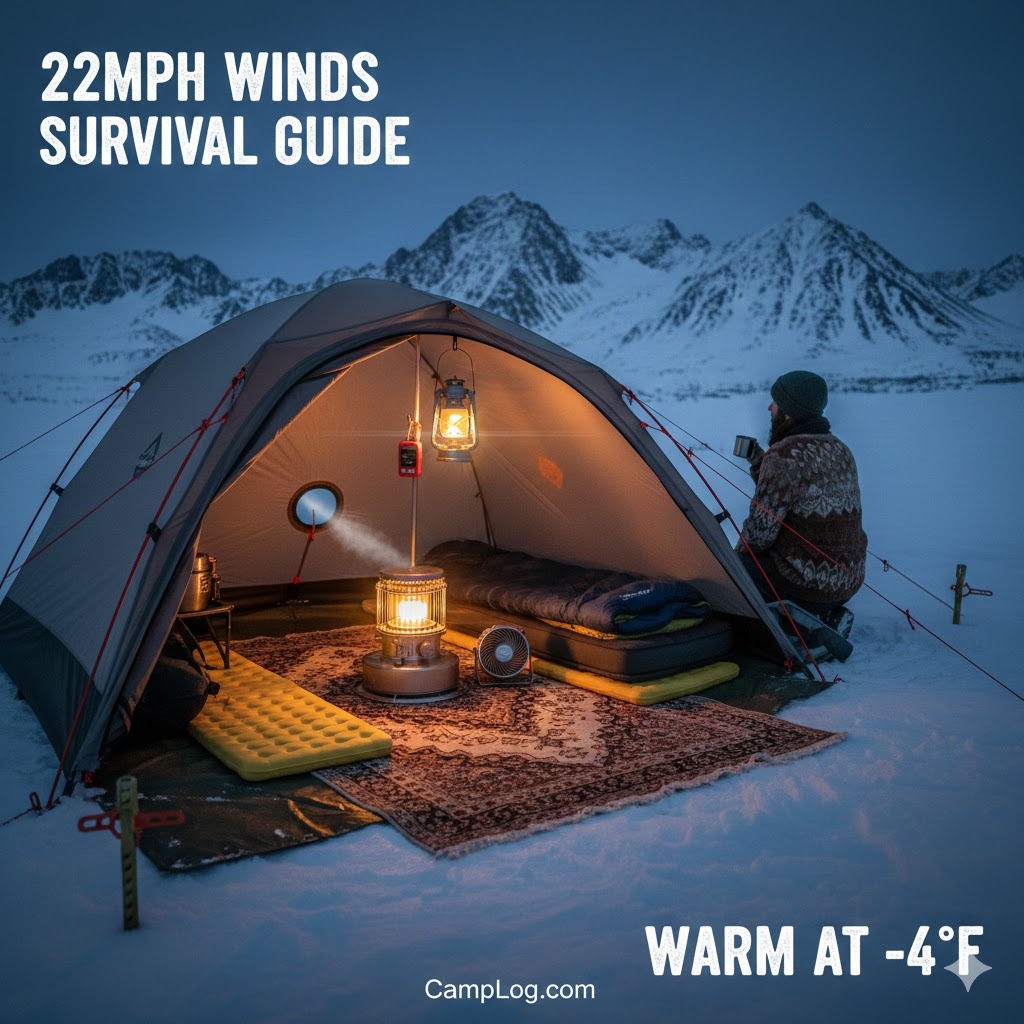
In the theater of winter camping, wind is the most volatile variable. Much like analyzing a stock’s volatility, a camper must perceive wind not as a breeze, but as a “structural load.” A sustained wind of 22mph (10m/s) exerts continuous pressure equivalent to a car driving 36km/h constantly pushing against your tent fabric.
The most common failure in high-wind scenarios is neglecting “Aerodynamic Orientation.” Tents have a “Windward Profile”—a side designed to deflect wind—and a “Leeward Profile.” For a tunnel tent, the broad side acts as a giant sail. If you take a 22mph wind on the side panels, the poles will experience “fatigue failure” from lateral oscillation. To prevent this, always pitch the lowest or most reinforced section of the tent to face the wind.
| Wind Type | Speed (m/s / mph) | Risk Level | Pitching Strategy & Sleep Quality | Expert Insight |
| Sustained | 0 ~ 5 / ~11 | Low | Basic corner staking is sufficient | Ideal camping conditions |
| Sustained | 6 ~ 9 / ~20 | Moderate | Full pole staking; 12-inch steel stakes | Recommended for most campers |
| Sustained | 10+ / 22+ | High | Full Guy Lines mandatory | Sleep is impossible due to noise |
| Sudden Gust | ~ 16 / ~35 | Danger | 16-inch stakes; constant tension checks | High risk of pole deformation |
| Sudden Gust | 17+ / 38+ | Extreme | Immediate evacuation recommended | Guaranteed gear failure/Injury risk |
When sustained winds exceed 22mph, “Full Guy Lines” are a necessity, not an option. The flapping of the tent fabric can exceed 80 decibels, creating a stress level similar to sleeping next to a busy highway. You must eliminate all slack in the tent structure to prevent harmonic vibration that leads to pole breakage.
A sudden 35mph (16m/s) gust can snap a pole like a twig. In my 15 years of experience, once gusts hit this level, the smartest investment you can make is protecting your assets—your gear. Retreating to your vehicle or an early pack-up is often the most “profitable” move in the long run.
2. Thermodynamic Heating: How to Stay “T-shirt Warm” at -4°F
Heating a tent at -4°F (-20°C) is not just about raw power; it’s about “Thermal Management.” You need to calculate the internal volume of your shelter and match it with the appropriate heat output (BTU). Treat your heating setup like a diversified portfolio: combine a primary heat source, air circulation, and ground insulation.
To maintain an interior temperature 50-60°F higher than the outside, you need roughly 1,500 kcal (6,000 BTU) per 35 square feet. A large 180 sq ft living shell requires at least 30,000 BTU. However, most high-end kerosene stoves only output about 20,000 to 23,000 BTU. Closing that 7,000 BTU “deficit” is the key to comfort.
- Medium Living Shells (100-140 sq ft): A 15,000 BTU fan heater is usually sufficient. However, if you fail to insulate the floor, you will lose 40% of your heat to the frozen ground through thermal bridging.
- Large Living Shells (180+ sq ft): A single unit won’t cut it. You need a strategy involving a primary 23,000 BTU stove supplemented by a secondary heater or a dual-fan heater setup.
- The Magic of Circulation: Hot air rises. While the ceiling might be 80°F, the floor could stay at 40°F. You must use a heavy-duty air circulator to force the “Thermal Ceiling” down to the floor level.
At -4°F, convection management is more critical than radiant heat. Even a small draft through the tent skirt can drop the “RealFeel” temperature by 10 degrees. Using heavy gear or snow to seal the skirts is a professional detail that pays dividends in warmth.
3. Survival Safety: The Biological Basis of the “4-Inch Rule”
Winter camping tragedies are almost entirely preventable through education. Carbon Monoxide (CO) is a “Silent Killer,” but kerosene heaters are safe when they have enough oxygen to maintain a “Clean Burn.” Precision, not paranoia, is what keeps you safe.
The “4-inch (10cm) ventilation rule” is the golden standard among extreme campers. This opening provides the minimum air exchange required for an adult’s respiration and the heater’s combustion. In a large living shell, you need to create a “Chimney Effect”—fresh air intake at the bottom and exhaust at the top.
The 3-Step Safety Protocol:
- [ ] Dual Detectors: Never rely on a single device. Place one at head height and another near your sleeping bag to account for different gas densities and air pocket movements.
- [ ] Strategic Ventilation: Your intake vent doesn’t have to be near your head. Placing it behind the heater allows the cold, oxygen-rich air to feed the flame directly, warming it before it circulates through the tent.
- [ ] Resisting the “Seal” Temptation: The most dangerous gamble is sealing every gap to save heat. A slightly colder tent is a small price to pay for your life.
Ultimately, winter camping is a game of response to the elements. Stake down heavily for the gales and calculate your thermal needs precisely for the cold. When data meets experience, your camping log becomes a testament to mastery, not just a weekend trip.