
Fiberglass. For those who enjoy camping or backpacking, a tent is more than just equipment; it is a ‘home’ in the wild. While many campers are sensitive to the design or fabric specs, they often overlook the tent pole materials that act as the pillars of the house. In extreme situations like sudden strong winds or heavy snow, it is not the pretty color of the tent that protects your safety, but the sturdy poles standing inside.
Today, we will take an in-depth look at the types and characteristics of tent pole materials from a professional perspective. The first subject is ‘Fiberglass’, a material that is both familiar and technically interesting.
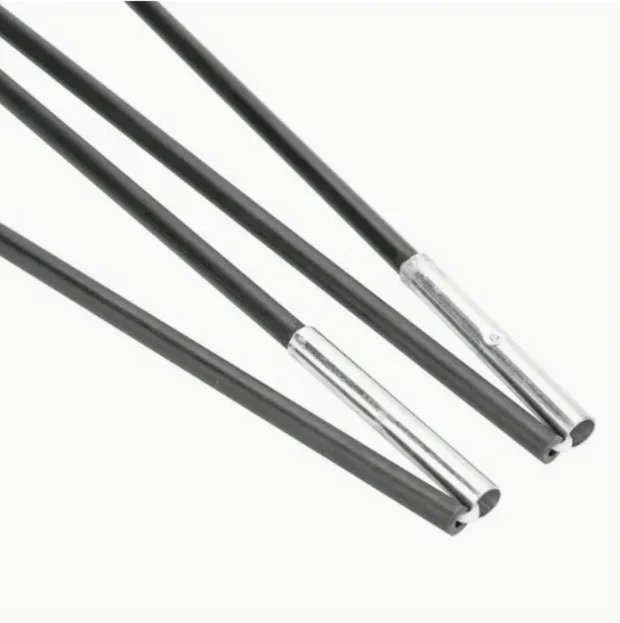
Step 1: Glass Fiber Forming
Fiberglass is a traditional material that has been widely used in the outdoor market along with steel poles. It is made by processing natural raw materials such as silica sand and limestone.
- Melting: Raw materials are placed in a giant furnace and heated to over 1,400°C–1,500°C.
- Spinning: The molten glass is sent to a device called a ‘Bushing’ with thousands of microscopic nozzles.
- Cooling: The glass becomes fibers thinner than a hair (5–24 microns) as it cools rapidly in the air.
- Sizing: A special chemical is coated on the surface so that the fibers do not get tangled and bond well with the resin later.
Step 2: The Pultrusion Process
The most interesting part is the process of making soft threads into hard poles. Unlike ‘Extrusion’, fiberglass uses the ‘Pultrusion’ method, which pulls the material through a die.
- Impregnation: Threads are gathered and passed through a tank of liquid polyester or epoxy resin. Ensuring the resin seeps into every gap is key to the pole’s strength.
- Curing: The resin-soaked fibers pass through a heated metal die. At this moment, the liquid resin hardens (cures) due to the heat, giving it the properties of a solid pole.
- Cutting: The finished poles are pulled at a constant speed and cut to the desired length. Since the cut surfaces are sharp, they must undergo precision grinding and sealing to become a safe finished product.
Advantages: Unique Elasticity and Recovery
The reason fiberglass poles still hold a unique position is their excellent ‘Elasticity’. This means they can undergo high deformation without permanent damage and return to their original shape. This makes them ideal for pop-up tents and fishing rods.
Disadvantages: The Danger of Fracture
However, the weaknesses of fiberglass are critical.
- Temperature Sensitivity: Durability drops sharply in sub-zero temperatures.
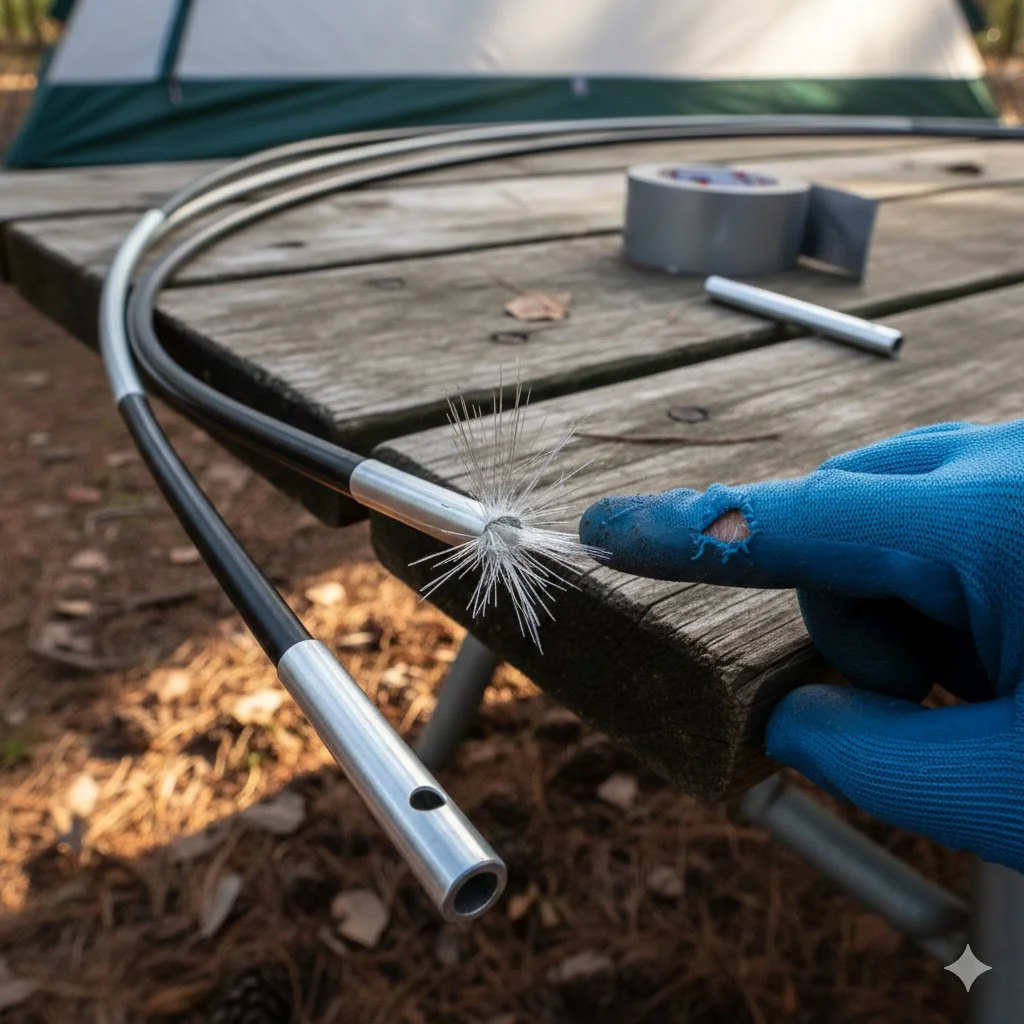
- Fiberglass Splinters: When it breaks, it scatters microscopic glass fibers. These are sharp, invisible, and can cause persistent pain if they get into the skin or respiratory system.
- Weight: To achieve strength similar to aluminum, they must be 20–30% thicker, which increases the overall weight of the tent.
Conclusion
Fiberglass poles are a great economical choice for ‘light outings’ or ‘budget summer tents’. However, if you are planning a professional backpacking trip or winter camping, I strongly recommend upgrading to aluminum (duralumin) poles.