
## The Lifeline of Backpacking: Why the Pros Bet on 7001
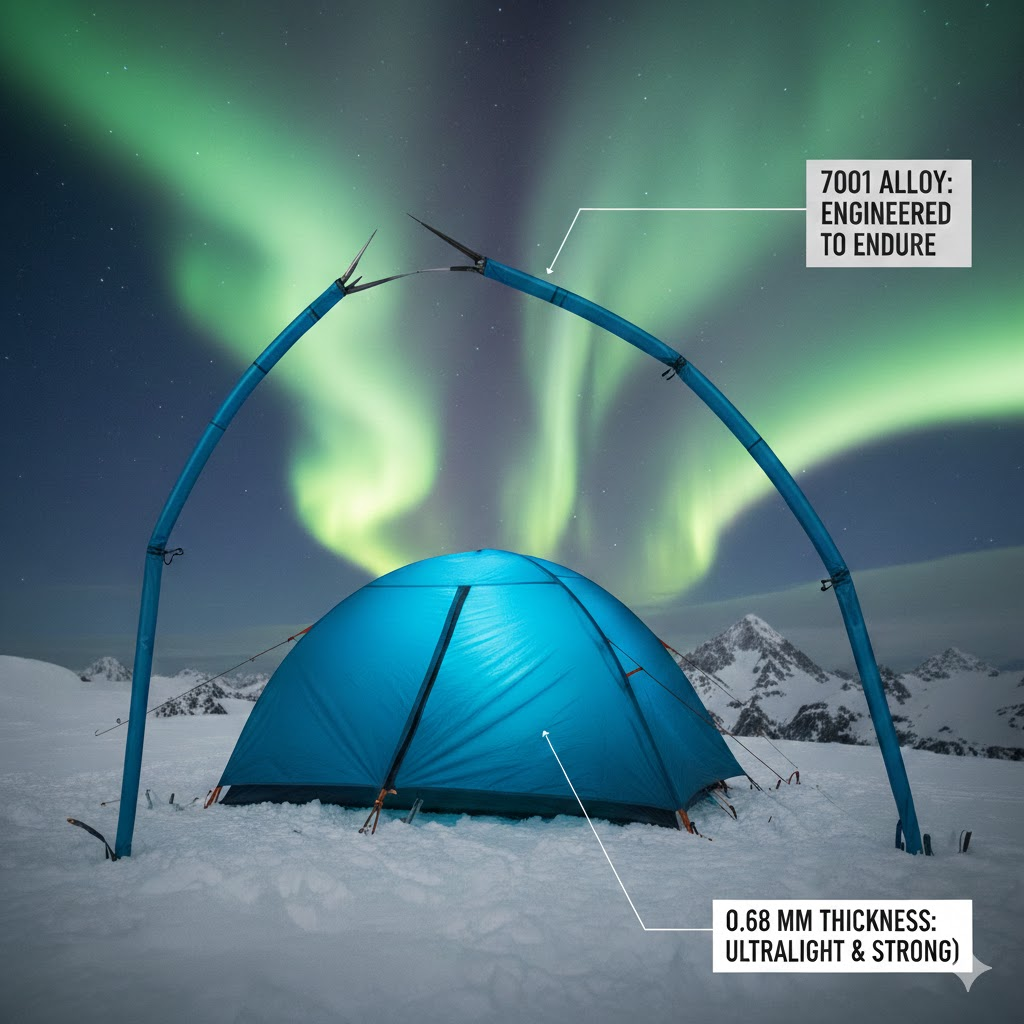
When you watch a documentary about a high-altitude expedition, those thin, vibrant tent poles holding up a tiny yellow tent in a blizzard are almost certainly made of 7001 Ultra-High-Strength Aluminum. While massive family tents for auto-camping rely on the cost-effective 6061 alloy, 7001 is a specialized “Aerospace-Grade” material designed for maximum strength with minimum mass. In the world of outdoor gear, if 6061 is your reliable dividend-paying stock, 7001 is the high-performance tech stock that offers peak utility at a premium cost.
## The Science of Strength: Zinc (Zn) and Precipitation Hardening
According to Matweb, the premier database for material science, 7001 boasts a tensile strength of 675 MPa, more than double the 310 MPa found in 6061. The secret ingredient? Zinc (Zn). Comprising nearly 15% of the alloy, Zinc atoms undergo a process called Precipitation Hardening. After being heated to 460°C and then aged at 120°C for 24 hours, Zinc forms tiny, ultra-hard clusters within the aluminum matrix. These clusters act as “atomic anchors,” pinning the grain boundaries and preventing the metal from deforming under the immense pressure of gale-force winds.
| Technical Property | A7001-T6 (The Pro Choice) | A6061-T8 (The Stable Choice) | SEO Expert Insight |
| Tensile Strength | ~675 MPa | ~310 MPa | 7001 doubles the load capacity |
| Elongation at Break | ~9% | ~8% | Superior elasticity in 7001 |
| Manufacturing Style | Seamless (Mandrel) | Seam (Porthole) | No structural weak points |
| Heat Treatment | T6 (Solution + Aging) | T8 (Cold Work + Aging) | Maximum atomic stability |
| Ideal Context | Ultralight Backpacking | Large Family Tents | Performance vs. Economy |
## Seamless Superiority: Eliminating the Weak Link
One of the most critical engineering differences is that 7001 is a Seamless Pipe. Most 6061 poles are made using a porthole die where the metal is split and rejoined, creating a microscopic Seam Line. While acceptable for casual use, this seam can become a failure point under extreme stress. 7001, however, uses Mandrel Extrusion, piercing the center of the billet to create a continuous, unified cylinder. This structural integrity allows 7001 to handle intense loads without the risk of splitting along a seam, making it the only choice for “no-fail” missions.
## The 0.5T vs. 0.7T Debate: Weight vs. Survival
The current trend in the backpacking industry is pushing pole thickness down to 0.5T (0.5mm) to satisfy the “gram-counting” ultralight market. While the high tensile strength of 7001 makes this possible on paper, it leaves very little room for error. A single micro-scratch or a slight manufacturing flaw can drastically compromise a 0.5T pole’s integrity.
In my professional experience, I always recommend at least 0.7T thickness for serious expeditions. Even if it adds 100g to your total pack weight, that 0.2mm difference acts as an insurance policy against unexpected snow loads or freak wind gusts. When you are miles away from the nearest trailhead, 100g of extra safety is worth its weight in gold. Don’t trade your survival for the bragging rights of a slightly lighter pack.
## The 10-Step High-Precision Process of 7001
Crafting a 7001-T6 pole is a labor-intensive journey requiring absolute temperature control:
- Seamless Extrusion: Creating a unified cylinder from 7000-series billets.
- Annealing: Softening the metal to prepare for high-pressure drawing.
- Drawing: Pulling the alloy through precision dies to reach final dimensions.
- Quenching: Solution heat treatment at 460°C followed by a rapid water quench to “freeze” the atoms.
- Straightening: Correcting any thermal warping for an arrow-straight finish.
- Industrial Cleaning: Removing oils to ensure a perfect finish during aging.
- Artificial Aging: A grueling 24-hour cycle at 120°C to finalize the T6 temper.
- Precision Cutting: Tailoring each section to the tent’s specific arc geometry.
- Chamfering: Rounding the edges to prevent snagging on tent sleeves.
- Anodizing: Creating a durable oxide layer to prevent corrosion, which Zinc-heavy alloys are prone to.
## Final Verdict: How to Choose Your Gear
Choosing between 7001 and 6061 comes down to Risk Management. 6061 is the king of “Predictable Failure.” It bends and yields, giving you a chance to react before the tent collapses. It is perfect for family camping where safety and space are paramount.
On the other hand, 7001 is the king of “Peak Performance.” It is incredibly strong and light, but it has a brittle failure mode—it won’t bend as much as 6061 before it snaps like a dry branch. For the serious backpacker, a high-quality 0.7T 7001 pole from a reputable brand provides the perfect balance of elite strength and realistic safety. Choose based on your environment, not just the price tag.