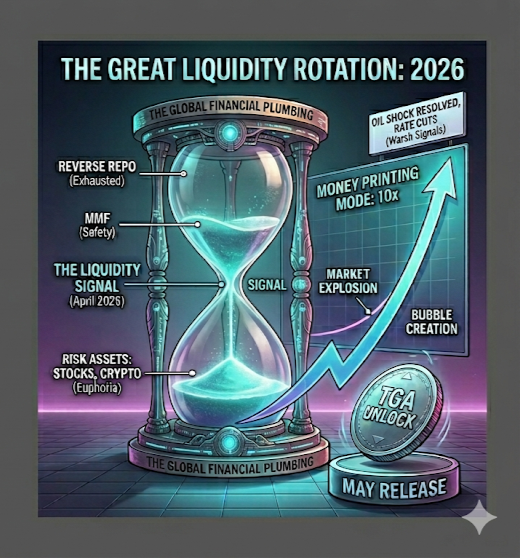
The Hidden Surge: Why April is the Calm Before the Storm
As of April 1, 2026, the financial markets are gripped by fear—fear of Middle East tensions and sticky inflation. However, a deeper look at the plumbing of the financial system reveals a massive liquidity dam ready to burst. Federal Reserve Chair Kevin Warsh has already signaled that oil shocks are transitory and rate hikes are off the table.
The real story lies in the Treasury General Account (TGA) and Reverse Repo (RRP) facilities. RRP balances have effectively hit rock bottom, meaning the Fed is no longer draining liquidity from the system. Meanwhile, the TGA—the US government’s checking account—is bloated. When the Treasury spends this money, it injects direct liquidity into the banking system, increasing reserves and fueling risk assets.
The Mechanics of Money Multiplication
The relationship between the TGA and market liquidity is mechanical. When the TGA balance rises (as seen recently due to Treasury issuance and tax collections), liquidity is sucked out of the market. When it falls, it’s like a massive stimulus package.
| Component | Current Status (April 2026) | Strategic Implication |
| M2 Money Supply | All-time high ($22.45T+) | Massive “dry powder” waiting for a trigger. |
| TGA Balance | Peaked/Sideways | Set to be released starting May for mid-terms. |
| Reverse Repo | Exhausted | Can no longer act as a liquidity sponge. |
| Investor Sentiment | High Fear / Parking in MMF | Primed for a “Great Rotation” to risk assets. |
The US Treasury has explicitly stated plans to drawdown the TGA starting in May. This is a classic pre-election maneuver to stimulate the economy before the November mid-term elections. April tax receipts may temporarily bump the TGA higher, but this only adds more water to the dam before the eventual release.
Why 4/1 is the Ultimate Entry Point
Smart money doesn’t wait for the news; it trades the expectation. By the time the TGA funds hit the market in May, the “liquidity rally” will already be in full swing.
- M2 and the MMF Wall of Money: Despite record M2 supply, stock performance has been lackluster because capital is hiding in Money Market Funds (MMF). Once the signal—a combination of Warsh’s rate cut and TGA spending—hits, this capital will rotate into stocks and crypto with violent force.
- The Post-War Oil Pattern: Historically, oil prices often drop below pre-conflict levels once geopolitical tensions stabilize. This will act as a massive deflationary tailwind, giving the Fed even more room to breathe.
Conclusion: End the Cycle of Regret
The market moves in cycles. If you mistime the cycle, you find yourself constantly trading against the trend. In this “easy game” where time is your greatest ally, failure only occurs when you miss the entry.
We are standing at the threshold of a massive bubble creation phase. The time to be cautious is not now, during the accumulation phase, but later, once the “money printing” has already occurred and euphoria takes over. Use April to build your positions. Don’t be the one saying “I should have bought” when the liquidity party is in full swing this summer.