
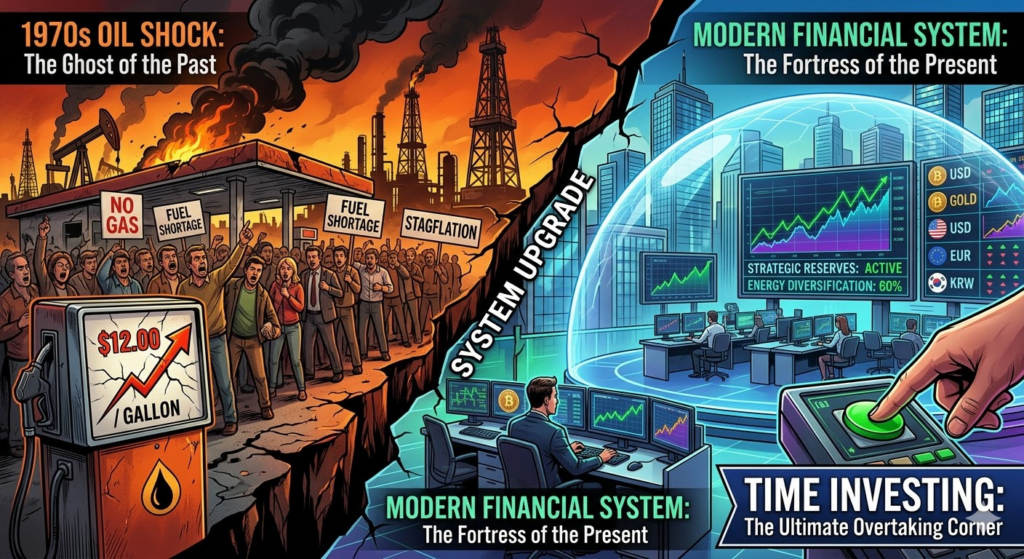
The specter of a ‘Third Oil Shock’ is haunting global markets once again. With geopolitical tensions flaring up in the Middle East, those with lingering trauma from the 1970s are sounding the alarms, predicting an imminent economic apocalypse.
However, we must view the market with surgical precision. Today’s financial infrastructure is light-years ahead of where it stood half a century ago. The era of information asymmetry is dead, and the rules of the game have fundamentally changed.
In this post, I will dissect why a catastrophic collapse, similar to those of the past, is highly unlikely. Furthermore, I will share why savvy investors view a downturn not as a disaster, but as the ultimate ‘overtaking corner’ in the race for wealth.
## 1. The Ghost of 1970s: A Fragile World Without a Shield
The reason the world was blindsided by the 1st and 2nd Oil Shocks was a total lack of contingency planning. Back then, there were virtually no viable alternatives to Middle Eastern oil, and tracking supply chains in real-time was a fantasy.
Because information traveled at a snail’s pace, the market was prone to massive overreactions. A single rumor of supply disruption could trigger nationwide hoarding, which in turn fueled the inflationary fire and led to stagflation.
Moreover, the financial markets of that era were incredibly rigid. Retail investors had zero tools to capitalize on a falling market. It was a time when ‘just holding on for dear life’ was the only available strategy.
## 2. 4 Fortresses of Modern Finance Against Oil Volatility
In the digital age, information moves at the speed of light. The moment a geopolitical event occurs, investors globally activate pre-set contingency plans based on real-time data analysis.
First is Energy Diversification and Strategic Reserves. Unlike the past, Strategic Petroleum Reserves (SPR) are meticulously managed, and the world now boasts powerful alternatives like shale oil and renewable energy.
Second is Financial Instrument Sophistication. Investors now have access to futures, options, and inverse ETFs. These tools allow market participants to hedge risks or even generate significant returns during a price drop.
Third is Algorithmic Execution and Buffering. AI-driven trading systems act as shock absorbers. They execute trades based on hard data rather than human emotion, effectively dampening the volatility caused by irrational fear.
Fourth is The Rise of the Educated Investor. Having survived multiple market cycles, modern investors are less prone to ‘panic selling.’ Instead, they wait for ‘dip-buying’ opportunities, providing a natural floor for falling prices.
## 3. The Downturn is a ‘Corner’ in Racing: The Art of Overtaking
I often say that the real money is made during the downturns. If you watch a high-speed race, position changes rarely happen on the straightaways. The most dramatic overtakes occur at the sharpest corners.
A bear market is that ‘corner.’ While the masses slam on the brakes in fear, the disciplined investor identifies the apex and accelerates through the turn.
Staying stoic when your portfolio fluctuates is part temperament and part skill. In the end, those who conquer their own impatience and dopamine-driven impulses are the ones who end up owning the market.
### [Then vs. Now] Comparison of Economic Crisis Response
| Category | 1970s-80s Oil Shock | Modern Financial/Energy System |
| Information Flow | Analog (Newspaper, TV); Slow | Real-time Social Media & Data Streams |
| Energy Dependency | Absolute reliance on ME oil | Shale gas, Nuclear, Renewables |
| Financial Tools | Limited to spot trading | Futures, Options, Inverse, Leverage |
| Market Sentiment | Unchecked Panic & Hoarding | Data-driven Risk Mitigation |
| Gov. Response | Reactive & Lagging policies | Proactive Liquidity & Rate Adjustments |
## 4. The Infinite Value of Time: Why Assets Always Rise
Given enough time, every crisis reveals itself as an opportunity. The global economy is designed to expand, and as long as fiat currency exists, its value will inevitably depreciate over the long term.
In this structural reality, high-quality assets and blue-chip companies are destined to trend upward. The difference between those who go broke and those who strike it rich lies in their conviction in the ‘Power of Time.’
The stock market fluctuates because of human greed and the constant pursuit of the next dopamine hit. But by stepping back and viewing the market through a lens of human psychology and history, we can wait for the right moment with composure.
## 5. Conclusion: Master the Turn, Secure the Win
Don’t be a victim of the fear-mongering headlines. The system is stronger than it looks, and you have more weapons in your arsenal than your predecessors ever dreamed of.
The task at hand is not to panic, but to audit your portfolio and simulate how you will steer through the ‘overtaking corner.’
Ultimately, investing is a battle against oneself. Once you realize that time is your greatest ally, the stock market ceases to be a source of anxiety and becomes your most fertile ground for wealth.