
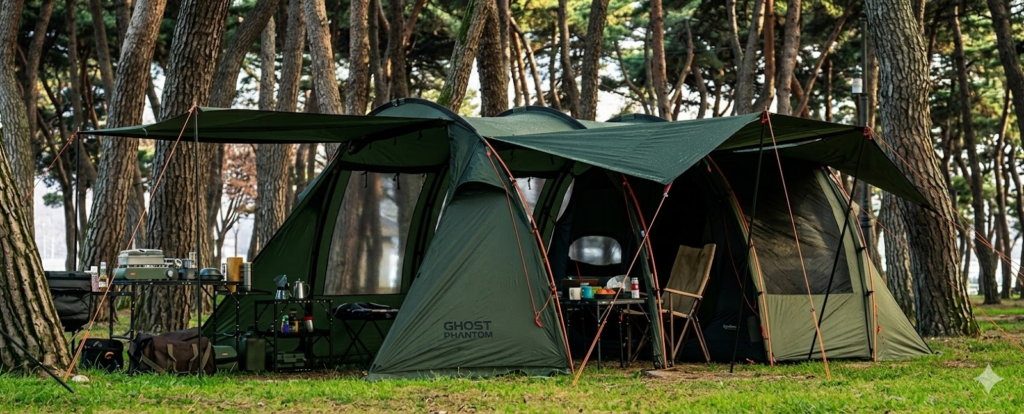
1. Introduction: Camping—Healing or Labor? Winning the Battle Against Time
In 2026, camping has increasingly become a battle against time. We leave home with hearts full of excitement, but the reality upon arrival is often stark. With most campsites setting check-in times at 1:00 or 2:00 PM, the “head of the household” or the designated gear master is immediately thrust into a high-intensity labor session. By the time the tent is pitched and the site is fully organized, the sun is already setting. You find yourself diving into dinner preparations without a single moment of true rest, and before you know it, “quiet hours” have arrived.
Even as you lie down in your sleeping bag, exhausted, your mind isn’t at peace. The stress of knowing you have to tear it all down as soon as you wake up the next morning looms over you. And if it happens to rain on departure day? That is perhaps one of the most frustrating moments a camper can face. We have all been there. This cycle of stress is exactly why it takes so much mental energy to plan the next trip.
This is why I now strictly adhere to a 2-night, 3-day camping philosophy. Considering the labor required for a full setup, a 1-night stay is simply too grueling. You need at least two nights to finally feel the unique relaxation that camping is supposed to provide. I once spent four nights in front of the West Coast ocean, and by the end, I felt so attuned to the wild that I wondered if I even needed a house anymore. Ultimately, to minimize this stress and find true leisure, the most critical decision starts with choosing the right tent.
2. Realistic Priorities in Tent Selection: The 5 Pillars
While we often get seduced by flashy designs on social media, the reality of the field forces us to evaluate a tent based on these five practical pillars:
- Volume (Packing Size): Vehicle storage is a finite resource.
- Weight: This determines your fatigue levels during setup and teardown.
- Living Space: The minimum area required for a family of four to actually “live” inside.
- Price: The rational compromise between cost-effectiveness and emotional satisfaction.
- Color & Design: The final aesthetic touch.
The Kovea Ghost Phantom is the rare item that harmonizes all these conditions perfectly. Unlike heavy cotton tents that people buy for the looks but eventually sell because of the weight, the Ghost Phantom is an “irreplaceable item” that captures both practicality and style.
3. Technical Specs of the Ghost Phantom: Engineering Excellence
To understand why the Ghost Phantom is irreplaceable, one must look at its hardware specifications, which are built like a high-performance machine.
[Table] Detailed Specifications: Kovea Ghost Phantom
| Feature | Detailed Specification | Expert Remarks |
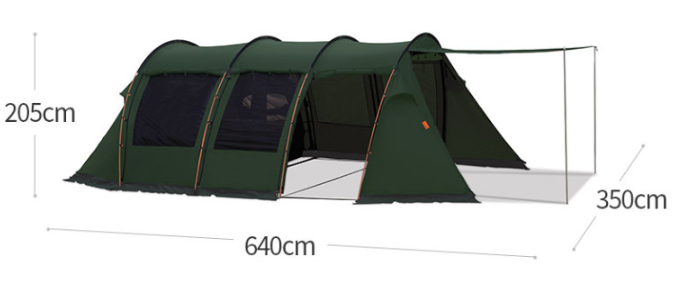
| Total Dimensions | 640cm(L) x 350cm(W) x 205cm(H) | Expansive living area for 4 people |
| Inner Tent Size | 330/240cm(W) x 225cm(L) x 185cm(H) | Optimized for a family of four |
| Body Fabric | 40D Nylon Ripstop | Lightweight with superior tensile strength |
| Coating Specs | PU, WR, Silicone, UV Cut | Reliable 2,000mm+ water resistance |
| Main Frame (Poles) | 7001-T6 High-Strength Aluminum | Premium aerospace-grade alloy |
| Total Weight | Approx. 17kg (Packaged) | Unmatched lightness for a living shell |
The frame of the Ghost Phantom is not made from standard 6061 aluminum. Instead, it utilizes 7001-T6 aluminum, an alloy used in aerospace and high-end mountaineering gear. This allows for thinner pole walls with significantly higher stiffness. While expensive, it reduces the total weight of the tent dramatically and offers incredible “elastic recovery” during high winds.
4. Pro-Tip: How to Lighten Your Load by Over 2kg
Even though the Ghost Phantom is light for its class, the stock Steel Pegs provided are quite heavy. While many campers believe “forged stakes” are the ultimate solution, I actually recommend Lightweight Aluminum Pegs.
- Use 190mm Aluminum Pegs: For standard auto-camping sites, 190mm is more than sufficient.
- The Weight Loss Secret: By replacing the heavy stock steel pegs with about 12 aluminum pegs and leaving the optional upright poles (used for the front canopy) at home when they aren’t needed, you can easily shave off over 2kg from the total package weight.
With this optimized setup, I can carry the Ghost Phantom with one hand or casually toss it over my shoulder. This small change completely transforms your energy levels at the start and end of your trip.
5. Metallurgical Analysis: 7001-T6 Poles and the Importance of Chamfering
The 7001-T6 poles in the Ghost Phantom are manufactured with a level of precision that sets them apart. When dealing with thin, high-strength poles, the joint integrity is everything. Specifically, the Chamfering (smoothing the edges) at the pole ends must be flawless.
Poorly finished edges in cheaper tents lead to Stress Concentration, which is the primary cause of poles splitting or cracking. In contrast, Ghost Phantom poles are precision-machined to suppress crack initiation. Furthermore, as the saying goes, “There is no such thing as a perfect seal” in anodizing. Since all anodized aluminum is somewhat vulnerable to long-term UV exposure, I highly recommend using the roof fly to protect both the fabric and the pole coatings, extending your gear’s lifespan to well over a decade.
6. Conclusion: Why a Practicality-First Expert Still Chooses the Ghost Phantom
For a camping expert who prioritizes practical utility above all else, the choice remains the Kovea Ghost Phantom. The only real downside to this tent, if I had to find one, is the “boredom” that inevitably comes from its flawless familiarity.
I haven’t ignored the rising trend of air tents. However, air tents have never quite aligned with my philosophy. The primary issue is Weight and Volume. In a world where car trunk space is a premium, having to carry a bulky air tent along with a separate electric pump is a major drawback. I also find the inherent anxiety of air tents unappealing—the fact that many feel the need to carry “emergency backup poles” anyway due to potential air beam failure feels like a redundant burden.
On the other hand, a pole-based tent like the Ghost Phantom offers a sense of structural certainty. Once you master the setup and use it a few times, the pole lines naturally form according to the direction of stress and tension. Unless there is an extreme external impact, it is very rare to find yourself unable to pitch a pole tent due to mechanical failure at a campsite. I simply haven’t felt that level of reliability or structural peace of mind with air tents yet.
Ultimately, the most efficient, lightweight, and secure way for a family of four to engineer their sanctuary in the wild is through the harmony of 7001-T6 poles and Nylon Ripstop. Choosing a tent based on fundamental engineering rather than aesthetic trends will transform your camping trip from labor into true relaxation.