
## The Engineering Backbone: Deep Dive into 6061 Duralumin
Following our exploration of fiberglass, we now pivot to the gold standard of modern camping: 6061 Duralumin (Al-Mg-Si). In the realm of material science, 6061 is not just a metal; it’s a high-performance alloy engineered for structural resilience and superior corrosion resistance. For campers who value gear with the scrutiny of a stock market analyst, understanding the molecular value of 6061 is essential. While high-tensile 7000-series alloys often steal the spotlight with their “ultra-light” marketing, 6061 remains the undisputed “Blue-Chip” material of the auto-camping industry.
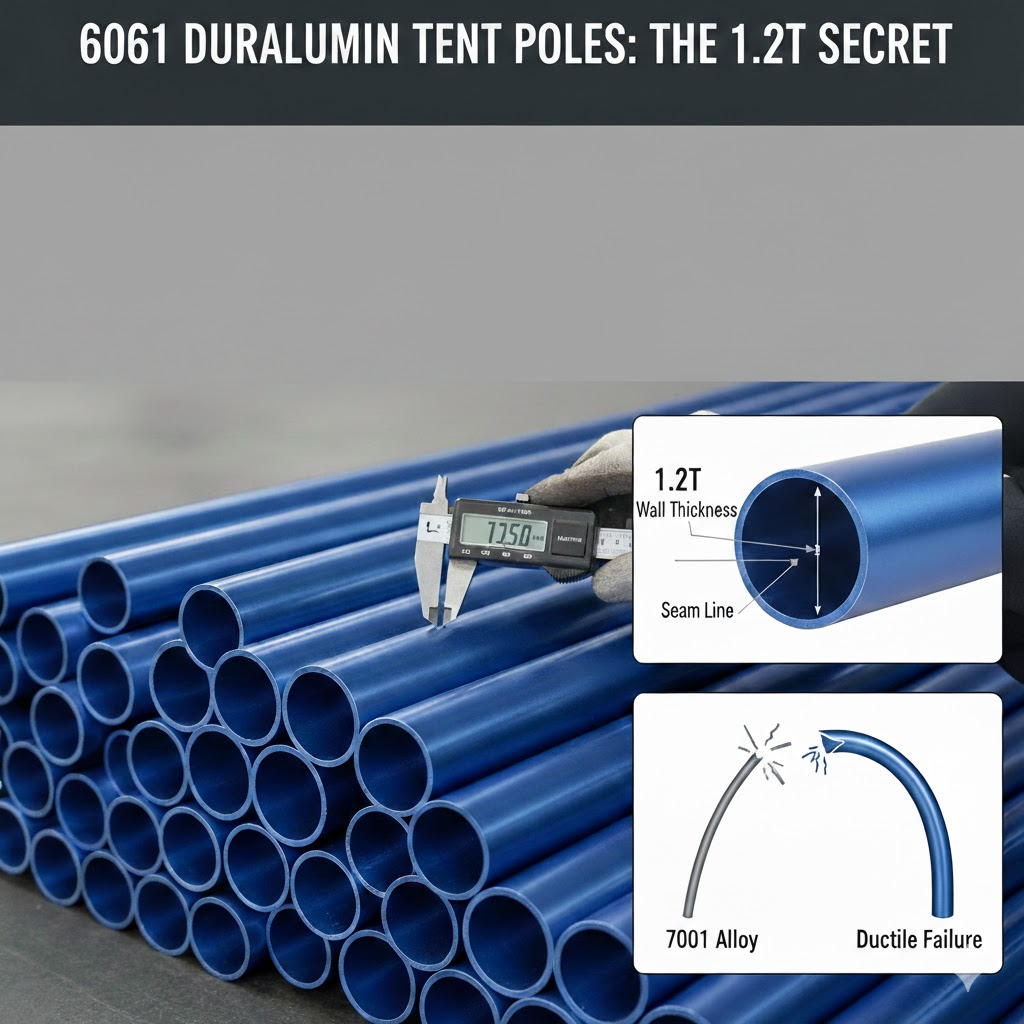
## Hardness vs. Toughness: Why 6061 Refuses to Snap
Have you ever seen a 7000-series pole shatter into sharp fragments during a storm? While it sounds like a gunshot, 6061 poles usually just bend or fold under extreme stress. This is due to the fundamental difference between Hardness and Toughness. High-tensile alloys like 7001 are extremely hard, meaning they resist deformation brilliantly, but they are prone to Brittle Fracture once their limit is reached. If you strike a 7000-series pipe with a hammer, it often shatters like glass.
In contrast, 6061 Duralumin exhibits Ductile Fracture. Under intense stress, the internal metallic structure undergoes a Slip Phenomenon, allowing the pole to fold or dent in the direction of the applied force rather than disintegrating. In the world of investing, if 7001 is a volatile high-growth stock, 6061 is the reliable bond that preserves capital—your tent’s structure—even when the market crashes during a storm. This ductility is a critical safety feature, ensuring that a failing pole won’t turn into flying shrapnel.
## The Science of T8 Temper and Press Quenching
The technical performance of 6061 is defined by its T8 Temper. This process involves Press Quenching immediately after extrusion, followed by cold working (drawing) and finally artificial aging to solidify the strength. Quenching is the critical step; by rapidly cooling the metal from 500°C to below 200°C in water, the alloying elements like Magnesium and Silicon are frozen in a solid solution.
| Property | 6061-T8 Technical Specs | Engineering Insight |
| Density | 2.70 g/cm³ | Reliable weight for stability |
| Yield Strength | ~240-270 MPa | Point of permanent deformation |
| Tensile Strength | ~290-310 MPa | Max stress before failure |
| Failure Mode | Ductile (Bending/Folding) | High energy absorption |
| Temper Code | T8 (Age Hardened) | Peak structural integrity |
| Corrosion Resistance | Excellent | Perfect for coastal air |
## The 9-Step Precision Manufacturing Process: From Billet to Backbone
- Billet Heating & Extrusion: Softened at 500°C and forced through a precision die.
- Press Quenching: Immediately flash-quenched in water to trap solutes.
- Drawing: Cold-worked through dies for dimensional precision and added strength.
- Straightening: Corrects micro-warping for an arrow-straight finish.
- Cleaning: Essential removal of lubricants before the heat treatment stage.
- Artificial Aging: Heated at 170-190°C to form precipitates, finalizing the T8 state.
- Precision Cutting: Tailored to exact tent specifications.
- Chamfering: Rounds the edges to safeguard the tent fabric and shock cords.
- Anodizing: Adds a durable, color-coded oxide layer for long-term protection.
## The 1.2T Engineering Limit: The Truth About Seam Lines
A common question among gear enthusiasts is: “Why can’t 6061 poles be as thin as 7001?” The answer lies in the Seam Line. During the extrusion of 6061, the flow of molten metal merges to form the pipe, creating a microscopic seam. This line requires a certain amount of material “meat” to maintain structural safety. To compensate for this, the industry-standard thickness for 6061 is approximately 1.2T (1.2mm). Shaving this down triggers Work Hardening, making the metal so brittle it bursts during production.
## Verdict: Why 6061 Rules the Auto-Camping Sector
In vehicle-based camping, 6061’s mass acts as a structural anchor, lowering the tent’s center of gravity. Its predictable failure mode—gradual bending—ensures that even in catastrophic wind, the pole won’t shatter and shred your tent. It’s the ultimate partner for family safety. Choose 6061 for its “fail-safe” properties and long-term durability. It is the silent protector of your camping experience.