
Introduction: While Your Portfolio Grows 15x, Someone Else Makes 72x
Most young professionals and beginner investors ask the same question: “Should I put my money in the safe S&P 500, or go for the high-growth Nasdaq?”
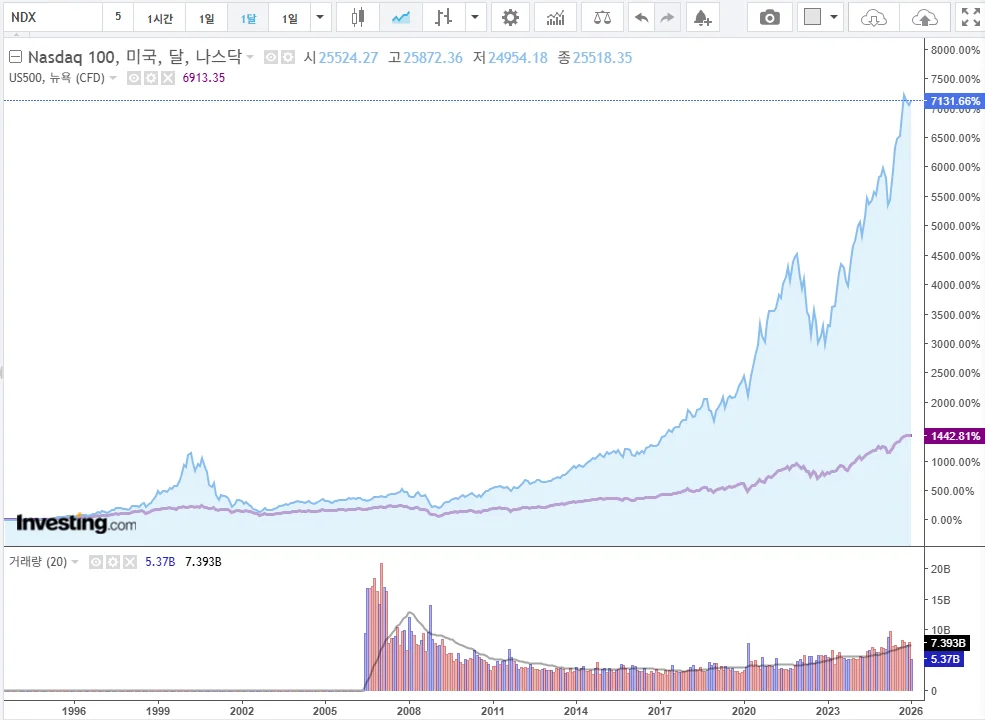
Both options mean investing in the massive U.S. market, but the final results are worlds apart. Over the last 30 years, while the S&P 500 rose by approximately 1,400%, the Nasdaq-100 achieved a staggering 7,100%. This isn’t just “earning more”—it’s a difference that changes your entire wealth class. In this post, I will explain why we should focus on the tech-centric Nasdaq-100 despite its volatility and share how to survive the rough journey from the perspective of a 10-year veteran investor.
1. S&P 500 vs. Nasdaq-100: Different Clubs, Different Rules
First, we must understand what we are actually buying. Instead of picking individual stocks, we invest through ETFs (Exchange-Traded Funds) that rebalance automatically.
- S&P 500 (SPY, VOO): Think of this as a club of the 500 biggest “all-rounder” top students in the U.S. It includes a wide range of industries, from Apple to Coca-Cola and McDonald’s. It represents the U.S. economy itself.
- Nasdaq-100 (QQQ): This is an elite club of the top 100 “IT Geniuses.” Tech giants like Google (Alphabet), Tesla, and NVIDIA are the stars here.
Even professional fund managers find it incredibly difficult to beat these indices. This is why we don’t need to stress over choosing individual stocks.
2. The 30-Year Truth: 15x vs. 72x Gains
Historical charts show the true power of the Nasdaq-100. If you had invested $100k, it would have become $1.5 million in the S&P 500, but $7.2 million in the Nasdaq-100. However, you shouldn’t be blinded by these figures alone. You must understand the “Valley of Returns.”
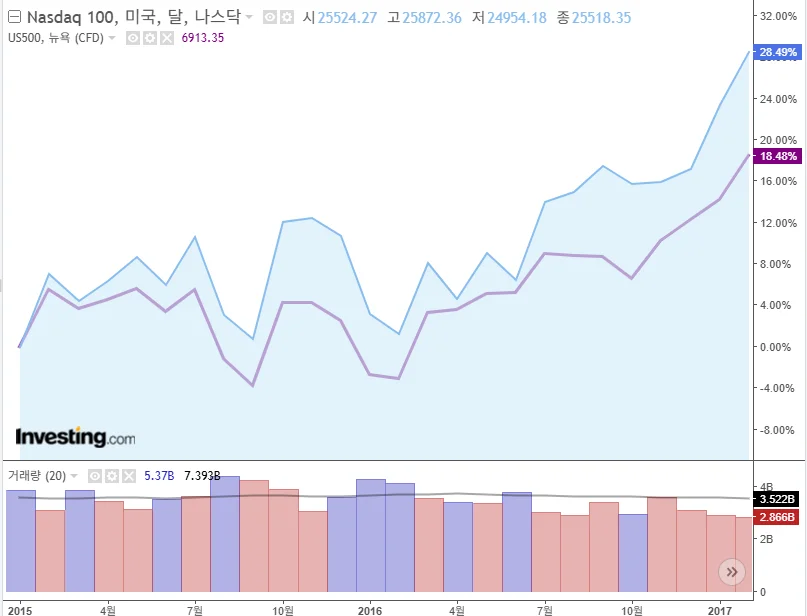
- The Volatility Gap: On a 30-year macro chart, the upward curve looks smooth. But if you zoom in, 10-20% drops were a common part of the journey.
- The Emotional Toll: When $100k turns into $110k and then suddenly drops to $99k, our brain feels real physical pain. Even the seemingly smooth upward trend between 2015 and 2017 was a mental battlefield for those who actually lived through it.
3. Why Choose the High-Volatility Nasdaq-100?
During the infamous Dot-com bubble, the Nasdaq-100 suffered a brutal -80% crash and took 15 years to recover. In contrast, the S&P 500 dropped -40% and recovered in 7 years. So why focus on the Nasdaq-100 now?
- Qualitative Market Shift: Unlike the empty promises of the Dot-com era, today’s Big Tech companies generate massive, tangible profits. We are now in an “Earnings-Driven Market.”
- A Learned System: Central banks and financial institutions have learned how to manage crashes through the 2008 crisis and COVID-19. Circuit breakers and tighter regulations now act as safety nets.
- Tech Opens the Future: The world evolves through technological innovations created by a few geniuses. During the 2022 downturn, Nasdaq dropped 33% and S&P 500 dropped 20%, yet their recovery times to previous highs were nearly identical (23 months vs. 24 months). Nasdaq fell harder but rebounded with much more force.
4. The Key to Success: Your Personal MDD and Cash Reserves
Ultimately, stock investing is a “game won by time.” To stay in this game, you must find the MDD (Maximum Drawdown) that your mental health can handle.
- The Size of Your “Money Bowl”: If you cannot sleep after seeing $33,000 vanish from a $100,000 investment, it is a sign that your investment is larger than your emotional capacity (your “money bowl”).
- The Magic of Cash Ratios: My secret to staying calm in the Nasdaq-100 is never being 100% “all-in.” By maintaining a cash reserve, you can trim profits during bull markets and “buy the dip” during bear markets. This turns market volatility into an opportunity rather than a crisis.
Conclusion: Start Investing to Win the Market
As long as the U.S. maintains its position as the global leader, tech growth will not stop. Do not let the short-term “spiky” graphs discourage you. In the long run, those painful moments are just small blips on a beautiful upward curve.
What is your investment style? Do you prefer the stable, “low-risk” S&P 500, or are you chasing the massive gains of the Nasdaq-100?
