
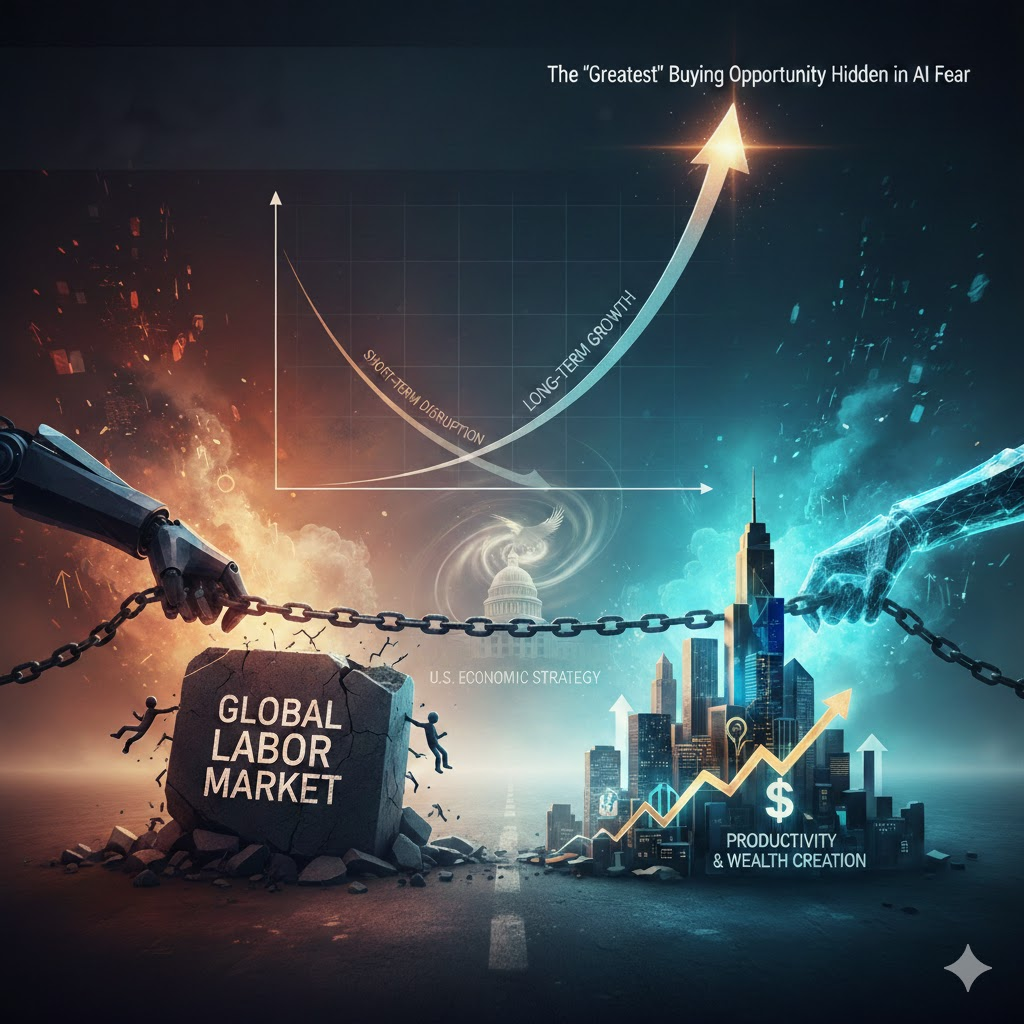
The ‘Greatest’ Buying Opportunity Hidden in AI Fear: Lessons from Industrial Revolutions
1. The 120% Debt Trap and the Productivity Escape Hatch
The U.S. debt-to-GDP ratio has breached the 120% mark, leading to a situation where interest payments are eating up a significant portion of the national budget. For the government, issuing more debt to stimulate growth is becoming a political and fiscal nightmare. Therefore, the only viable path forward is to engineer a scenario where interest rates fall, easing the debt burden, while the private sector picks up the slack.
The U.S. government is essentially attempting to provide a “hard floor” for the economy through rate cuts, tax incentives, and strategic support for specific sectors like AI and semiconductors. They need the private sector to drive productivity through technological breakthroughs. When corporate growth fuels GDP expansion, the government gains the fiscal breathing room to manage its debt and eventually regain its ability to leverage for future growth. This is the master plan behind the current economic pivot.
2. The Warsh Doctrine: A Collaborative Fed for a New Era
The potential appointment of Kevin Warsh as the next Fed Chair is a pivotal piece of this puzzle. While critics point to his hawkish stance during the 2008 crisis, his recent commentary reveals a sophisticated understanding of the modern economy. Warsh argues that AI-driven productivity is fundamentally disinflationary, meaning it allows for economic growth without the traditional spike in prices.
[Image Placeholder: The Synergy between AI Innovation and Monetary Policy]
This perspective suggests a Fed that is no longer an isolated, rigid institution but one that works in tandem with the government’s strategic goals. A “Warsh-led Fed” would likely scale back the central bank’s overreach, trusting that AI-led efficiency will keep inflation in check. If the Fed accepts that technology is doing the heavy lifting on inflation, the justification for high rates vanishes. For the savvy investor, this represents a massive liquidity injection waiting to happen—a “Warsh Put” that could define the next decade of equity growth.
Historical Comparison: Technological Revolutions & Economic Impact
| Category | 1st/2nd Industrial Revolutions | 3rd Digital Revolution | 4th AI Productivity Revolution |
| Primary Catalyst | Steam Engine, Electricity | PC, Internet | Artificial Intelligence, Robotics |
| Displaced Labor | Coachmen, Manual Laborers | Typists, Switchboard Ops | Data Clerks, Customer Support |
| Newly Created Roles | Mechanics, Technicians | Software Engineers, IT Sec | Prompt Engineers, AI Auditors |
| Fiscal Stance | Infrastructure Expansion | Digital Highway Funding | Targeted Subsidies & Tax Cuts |
| Market Outcome | Rise of the Middle Class | The Information Age | Hyper-Personalized Wealth |
3. Temporary Displacement vs. Permanent Innovation
The narrative that AI will decimate the labor market is a classic case of short-term myopia. History is our greatest teacher in this regard. When the railway replaced the horse and carriage, the “coachman” became a relic of the past. However, the railway didn’t just replace travel; it invented the modern logistics, tourism, and manufacturing industries, creating millions of jobs that were previously unimaginable.
We are currently witnessing the same phenomenon. AI is liberating human intelligence from repetitive, low-value tasks and pushing the workforce into creative and high-stakes problem-solving roles. While temporary spikes in unemployment data may occur, they serve as a “dovish catalyst” for the Fed to ease monetary policy further. This creates a feedback loop: technological displacement leads to lower rates, which in turn boosts asset prices and funds the next wave of innovation.
5 Critical Checkpoints for Global Investors
- Debt Servicing Ratios: Are lower rates effectively reducing the U.S. government’s interest-to-revenue ratio?
- Corporate Margin Expansion: Are S&P 500 companies showing clear margin growth from AI integration?
- The “Warsh” Consistency: Does the Fed transition toward a productivity-led policy framework?
- Job Market Resilience: Are new tech-centric sectors absorbing the labor displaced from traditional roles?
- Sector-Specific Tailwinds: Is capital flowing into state-backed industries like Bio-tech, Energy, and Chips?
Conclusion: Volatility is the Price of Admission for Generational Wealth
If my 15 years in the markets have taught me anything, it’s that the most profitable opportunities are always hidden behind a wall of fear. The current AI anxiety and debt concerns are the very things that keep the “smart money” buying while the “weak hands” sell. The government is committed to protecting the downside, and the AI revolution is engineering the upside.
The survival of U.S. global hegemony and the resolution of the debt crisis are now inextricably linked to the success of AI. Do not be distracted by the short-term headlines. Stay focused on the macro shift: we are entering a productivity-led growth cycle that has the potential to be the greatest wealth-creation event in history. The window of opportunity is wide open—for those brave enough to look past the fear.
7 Essential Strategies to Master the 2026 Liquidity Market with a 20-Step Split Purchase