
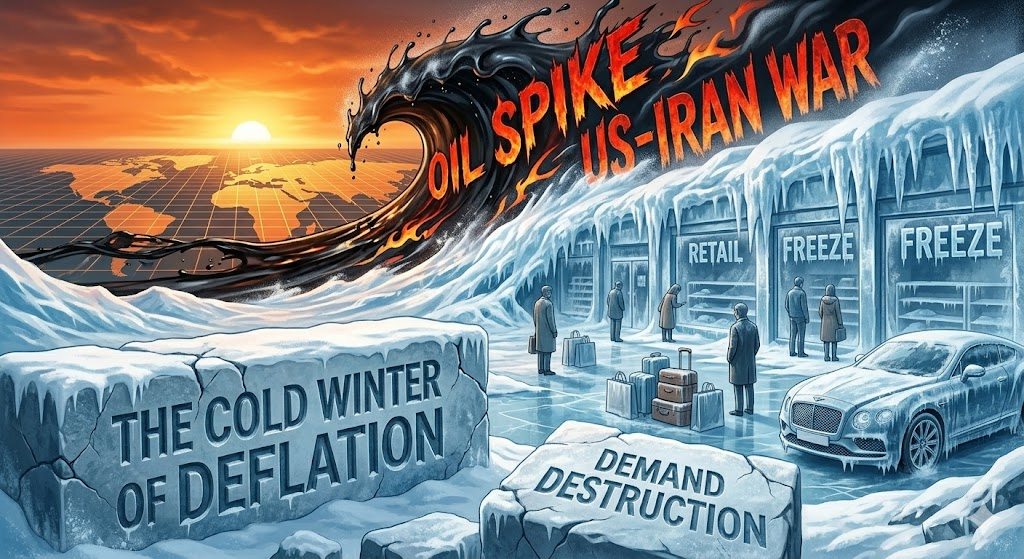
The US-Iran war is sending massive shockwaves through global oil markets. Most mainstream media outlets are quick to sound the alarm, predicting that soaring gas prices will trigger uncontrollable, hyper-inflationary spikes across all sectors. However, this is a dangerously narrow view that completely ignores the fundamental realities of the market.
We might actually be standing at the precipice of massive deflation, not inflation. True inflation requires an abundance of consumer demand and a willingness to spend. Simply having raw material costs spike does not guarantee endless price hikes; it is merely a temporary shock to the system.
Today, we will break down the 4 stages of how surging oil prices force consumers to aggressively tighten their belts, leading to severe demand destruction and, ultimately, deflation. We will move beyond dry macroeconomic theory and look at the highly tangible realities happening in our daily lives right now.
1. Understanding the True Essence of Money and Inflation
In basic economics, true inflation is driven by the depreciation of currency value backed by overwhelming consumer demand. Companies can only raise prices—and have those prices stick in the data—when people have an insatiable desire to spend money. The oil price surge caused by the US-Iran geopolitical crisis is entirely different.
This type of cost-push inflation acts like a aggressive, hidden tax that eats away at consumers’ real income. When your paycheck stays the same but the cost to fill your gas tank skyrockets, you inevitably slash spending on everything else. The moment prices jump at the pump, immediate demand destruction begins to ripple through the economy.
When demand freezes, businesses simply cannot pass their increased production costs onto the consumer. Products stop selling, inventories pile up, and companies are forced to slash prices or cut production to survive. This is the dark underside of the market that sensationalized inflation metrics completely fail to show us.
2. The Onset of Demand Destruction in Daily Life (The Psychological Barrier)
Let’s step away from theory and look at a highly realistic example. In my household, we operate two vehicles: a luxury gasoline SUV for long-distance weekend trips, and a mid-size sedan running on LPG for daily commuting. When the US-Iran war broke out, I watched gasoline prices spike by an astronomical 300 KRW per liter practically overnight.
That single event completely altered our weekend travel patterns. Instead of taking the gas-guzzling luxury SUV, we either squeeze into the cheaper LPG sedan or cancel our long-distance road trips entirely. Mathematically speaking, even with a 300 KRW/L hike, the actual cost difference to fill the entire tank is barely around 20,000 KRW.
When you consider that a typical weekend getaway costs around 300,000 to 400,000 KRW in food, lodging, and activities, that 20,000 KRW difference is statistically insignificant. Furthermore, gasoline prices eventually stabilized a bit after the initial shock. Yet, the intense ‘psychological burden’ implanted in the consumer’s mind does not simply wash away.
Comparison of Consumer Psychology and Behavior Pre/Post Oil Hike
| Category | Before Oil Surge (Normal) | After Oil Surge (Current) | Broader Economic Impact |
| Vehicle Choice | Default to luxury gas SUV for trips | Switch to LPG sedan or stay home | Dropping revenues for refineries and gas stations |
| Travel Frequency | Long trips at least once a week | Reduced to 1-2 times a month | Severe hit to local tourism, hospitality, and dining |
| Spending Mindset | Comfortable spending 400k KRW/trip | Extreme psychological freeze over a 20k KRW hike | Massive plunge in overall household discretionary spending |
3. The ‘Inflation Illusion’ Triggered by the US-Iran War
As the table clearly illustrates, the psychological resistance to spending an extra 20,000 KRW on gas completely annihilated 400,000 KRW worth of spending in the local economy. People cancel vacations, eat out less, and delay buying new clothes simply because they “feel” gas is too expensive. This is the terrifying butterfly effect of plunging consumer sentiment.
The news screams that expensive oil will make food and shipping costs skyrocket, warning us of endless inflation. But when consumers have locked their wallets shut, raising retail prices is basically financial suicide for a business. Behind the scenes, a quiet, desperate war of price-cutting is beginning in the retail sector just to survive.
How will this actually reflect in macroeconomic data? In the very short term, the oil spike might temporarily artificially inflate the Consumer Price Index (CPI). But very soon, the massive swamp of demand destruction will swallow those inflationary pressures whole, dragging the actual economic metrics violently downward.
Checklist to Escape the Inflation Illusion
- Track Core CPI Trends: Always check if core inflation (excluding volatile food and energy) is actually rising.
- Monitor Retail Inventory Levels: Are warehouses filling up with unsold goods? This signals massive incoming discount pressure.
- Analyze Consumer Credit Card Data: Is the actual, absolute dollar amount of monthly household spending growing or shrinking?
- Compare Essentials vs. Discretionary Goods: Grocery bills might be up, but watch how prices for electronics, cars, and luxury goods are quietly dropping.
4. Conclusion: Soaring Oil is the Trigger for Deflation
In conclusion, the oil price surge stemming from the US-Iran conflict is miles away from healthy, demand-driven inflation. Consumers merely feel like the world has become “tougher to survive in,” but in the real, ground-level market, devastating demand destruction is occurring in real-time.
In a market entirely devoid of demand, absolutely no product can sustain a high price tag indefinitely. Once the temporary supply shock of the war fades, what awaits us is not a hyper-inflationary nightmare, but rather the freezing, bitter winter of deflation.
When analyzing the economy, we must never get buried in the superficial numbers parroted by the evening news. The reality of your own wallet snapping shut, and your neighbors canceling their weekend trips—that profound psychological freeze—is the most reliable, leading macroeconomic indicator you will ever find.